Followers

Sunday, April 15, 2018

MOUNTAIN LION LADY: Chapter 3 (first half)

Mut (1)
Mut and me in front of the house we shared
Elaine and I worked out a very elaborate plan for Mut after my graduation. I was going to work in Germany for a year, so Elaine agreed to take care of him for one semester until Gray (who was miraculously still my boyfriend after the cockroach incident) was back on campus. He had agreed to take care of Mut until my return. It was a solid plan but turned out to be a mirage that disappeared when put to the test. Elaine and her new housemate did not see eye-to-eye on much so Elaine moved to a new apartment. Unfortunately pets were not allowed. Mut was bundled off to Aunt Mary X who lived 40 miles away.

Aunt Mary X while not a complete felophobe didn't really care for cats. Fortunately her cleaning woman did and agreed to take Mut. She loved cats to excess and was soon smitten with him. Aunt Mary X's letters were filled with Edith's descriptions of the wonders of Mut. The one cloud on the horizon was Mut's happy-go-lucky life out-of-doors was curtailed. Edith lived near a factory that regularly put out rat poison so she would only let Mut go outside on a leash. In installments I learned about Mut's adventures with the neighborhood feral tom who somehow avoided poisoned rats. Upon the first meeting with the tom Mut swelled to magnificent portions with his long hair puffing out from his body and his tail twice its usual size. According to Edith, his vocalizations were something to behold. The lion in him came roaring out. It turned out to be a paper lion because after the first episode he would carefully check for the tom's presence before venturing outside and refuse to budge if his nemesis was anywhere near. Periodically they would meet in spite of Mut's best efforts and they would again have words.

All would have been well had Mut's ailment not developed. One morning he went to use the litter box but nothing came out. He shuffled around the house hunched over and uncomfortable until Edith became concerned. She called Aunt Mary X and Aunt Mary X took Mut to the vet. The vet diagnosed bladder stones and advised them that Mut should be allowed free movement outside so he could relieve himself whenever he felt the urge. We still don't know exactly what causes formation of bladder stones but the diet and not free-will urination is often suspected. No one knew that at the time. Aunt Mary X and Edith, to say nothing of Mut, were in a quandary: death by poison or death by bladder stones? What to do? Aunt Mary X was rarely at a loss for solutions for long, so she was soon on the phone talking to my sister Julie.

Julie was in medical school in Denver and living in a house with three other women, a man (no hanky-panky, just another impoverished medical student) and two cats. Charo was an attractive, dark female and her sister Fuma was a rather odd light gray. Her color wasn't odd - it was her personality. She would stare at the wall for hours then suddenly leap into the air and disappear. They often called her Schitzy-Fu.

Julie and Aunt Mary X decided Mut would be better off in Colorado. Arrangements were made for Julie to meet his plane and he was in Colorado before Daddy had a chance to splutter about the price.

Mut flourished in Denver. The other two feline residents were pampered aristocrats and Mut got to share their expensive cat food. His bladder problem seemed to clear up. The only other cat in the neighborhood was a rather dominant tom next door but they had soon worked out an arrangement with no bloodshed. Mut mostly learned to stay out of his way (he really was of debatable courage as his name (see chapter 2) suggests!).

Mut appeared to have accepted with equanimity my desertion to Germany, his removal to Edith's, and even his flight to Denver and installation in a crowded house. But every cat has his limits! Mut's were reached when Julie went to western Colorado for a two-month externship. He quietly had a breakdown. Every day he retreated to Julie's bedroom and started grooming the fur right off his beautiful, fluffy tail! When Julie finally returned he looked like a ball of thistledown with a skinny rat tail attached! His tail was completely hairless. Just by being there Julie restored his confidence and within a few months his tail was restored to its former glory.

The man of the house moved out and one more woman, Amy, moved in. Amy was accompanied by Daphne, a lovely black second-generation Siamese. Mut was the only even faintly masculine member of the household until the pedigreed puppy arrived. Gail, a secretary in a house filled with med students or scientists, must have felt in need of an ally. She decided the little Lhaso Apso fit the bill. It didn't seem to matter that he was expensive (all the other animals were rescues) and she had no money. The little puppy was as scatterbrained as his owner. Gail kept her messes confined to her room, but the puppy shared his throughout the whole house. The cats were indignant!

The household was adjusting itself to the puppy when I returned from Germany. I decided to work at the medical center for a year or so until I decided in what field of graduate study I was most interested. The only room available to me was the closet of Amy's room. Her room had originally been the recreation room and the closet was a large, well-lit one in the basement.

Six women, four cats and one puppy in what had been built as a two-bedroom house. The previous owner was an inveterate do-it-yourselfer. He had constructed a rather bewildering catacombs in the basement, subdividing it so four more-or-less bedrooms were available. Julie and Martha, a biochemist, occupied the only real bedrooms upstairs. 

Martha's mother was Honduran and Martha had a strongly Catholic bent flavored with Latin American flair. Now and then she needed a duenna, a role which Gray on one occasion was able to fulfill. Gray was in Denver for a short visit before joining a research ship bound for southern Chile and Argentina. Julie let him have her bedroom (what a sister!) and she and I took turns sleeping on the floor of my closet cum bedroom. One night the whole crowd went to a party for Amy's Spanish class. Martha wore an authentic, flamboyant Honduran costume. Julie was resplendent and entirely out of character in a glittering gold lame (sorry - the blog program won't let me type an accent) outfit of Amy's.

Amy was tall and beautiful and rather enamored of her teacher. Martha flirted with the teacher's South American friend. One thing led to another and the two men were invited to our house for coffee. We all retired except Martha, Amy and the two Don Juans. Finally Amy also went to bed leaving Martha and the two Latin lovers. Amy's teacher fell asleep on the sofa which stimulated the South American fellow to new heights. Martha noisily fought him off which seemed to further inflame his ardor. She struggled over to Gray's door and desperately appealed for help. Gray threw the two out. When I woke Martha for work the next morning she was still fully clothed. She was terrified the rebuffed Don Juan would return!

Julie graduated and the household split up. Martha, Charo, Fuma, Mut and I moved into a one-bedroom apartment. This time I got the living room instead of a closet. Mut's next adventure was about to begin.

I was wary of keeping Mut inside for more than a few days because I still believed that if he was penned up the bladder stones might form again. One evening I took him outside to look around. He sniffed at the bushes but made no move to run away. I stayed with him for about a half an hour, then called for him to come in. I usually gave him food when I called him and he was always ready for a bite to eat! 

The next evening I let him out for a short time but didn't stay with him. A mistake. When I called him he didn't come running. I called and called.

"He's probaly gone back to the house," Martha sensibly suggested. The house was only a few blocks away but across busy Colfax Avenue. I had visions of a squashed and lifeless Mut and took off running and calling towards the house. I was relieved not to find his body but worried because he had not turned up at the house. I walked and walked, calling and calling, but there was no answering "Mrrow?"

I visited the humane society shelter (they encouraged me to take another cat), put ads in the newspaper, had several radio stations announce that Mut was missing, all to no avail. I finally admitted to myself that Mut, like Fluffy before him, had disappeared. Good old lazy, lovable Mut. He'd caused my family and friends so much bother but I still loved and wept for him. Little did I know what he had in his absence lined up for my further edification!


Sunday, April 8, 2018

TEDDY AND THE WEASEL WORDS

Image result for teddy roosevelt free images
Theodore Roosevelt

The assassination of William McKinley in 1901 catapulted vice-president Theodore Roosevelt into the presidency. Although Van Roosevelt is an old Dutch family name that means from the field of roses, Teddy Roosevelt's seven years as president were no bed of roses (I think that phrase must refer to a bed of rose petals - a bed of made from rose plants would be worse than a bed of nails)!


One name often associated with Roosevelt is Rough Riders. This term was not coined by or for Roosevelt himself. It had been used for more than 100 year to mean a bronco buster, but was appropriate to the group of cavalry assembled from cowboys and other outdoorsmen who could ride and shoot for the U.S. Army in the Spanish-American War of 1898.


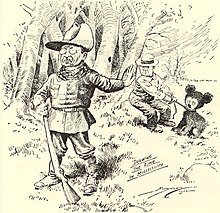
A 1902 political cartoon in The Washington Post
spawned the 
teddy bear name.
Teddy bears really were named after him. He refused to shoot a little bear tied to a tree and insisted that it be released. The newspapers got hold of the story and the cartoon on the left entitled "Drawing the line in Mississippi" was reprinted in hundreds of publications about the incident. Toy makers, just as opportunistic then as businesses are today, produced the endearing teddy bear.

Another phrase attributed to Roosevelt is "weasel words". The term probably didn't originate with him, but he certainly used the phrase a lot. It means words that weaken the effectiveness of another word or expression. Roosevelt used the expression in a 1916 speech urging action by the Wilson administration toward Germany for their seizures of American merchant ships. He said that the rhetoric from the State Department was filled with weasel words. "When a weasel sucks eggs the meat is sucked out of the egg. If you use a 'weasel word' after another there is nothing left of the other." The idea of a weasel sucking eggs appears in Shakespeare's Henry V (" The weasel Scot comes sneaking and so sucks the princely egg.") and As You Like It ("I can suck melancholy out of a song as a weasel sucks eggs.") Weasels probably do eat birds' eggs but they probably don't suck them out, rather bite a hole and lick them out.

Although use of weasel words is a specialty of politicians we have all probably tried to weasel out of something. This expression is related to the weasel's phenomenal ability to escape from tight places. Those of you who have owned the weasel's cousin, a ferret, as a pet have probably experienced this. The weasel has a slim, muscular body and narrow, elongated skull. That and its tenacity and fierce temper make such exits possible.

Weasels and other predators are often assigned dubious characteristics by humans. Humans, the most predatory of all, like to call other predators evil. We need to realize evil has to do with intent, not dinner. In earlier times a deceptive young woman was called a weasel and a weasel symbolized supernatural evil (sharing that symbolism with black cats).

Two species of weasel are found in Colorado. Both the long-tailed weasel and its smaller, less-common cousin the short-tailed weasel turn from brown in the summer to white in the winter except for a black-tipped tail. Hawks and owls (major predators of weasels) are sometimes fooled into striking at the bobbing black tail instead of the body.

The word "weasel" is probably related to the Sanskrit word "visra" which means musty-smelling. Weasels are members of the family Mustelidae. The whole family is pretty smelly, especially skunks. The origin of the word mustela which is Latin for weasel is probably mus (mouse, not a word for smelly), and means it catches mice, which it does. The word weasel can be traced from the Old English wesole or wesole through the Middle English wesele to our weasel.


All around the cobbler's bench
The monkey chased the weasel.
The monkey thought it all in fun.
Pop goes the weasel!

Many variations of this nursery rhyme exist with the only constant being "Pop goes the weasel". Likewise there are many explanations for the origin of this rhyme. I have two favorites for the weasel involved. One concerns a spinner's weasel. It is a large spoked wheel on which yarn is wound after spinning. After 80 yards has been wound the wooden gears inside make a popping sound so the spinner knows it is time to cut off the yarn and tie it into a skein. The other also concerns the garment industry. An iron formerly used by tailors was called a tailor's weasel that was heated on a wood-burning stove. The tailor would spit on it and listen for a pop which would indicate the temperature was right for ironing. Why were they called weasels? One explanation I read was "weasel" was a corruption of "weevil" (a snouted little bug), but that makes no more sense than weasel! It'll just have to remain a mystery!

The descent of a modern word or phrase from an animal origin is often obscure. It is sometimes unflattering but always should prove interesting. I welcome any questions or suggestions!

Monday, April 2, 2018

MOUNTAIN LION LADY: Chapter 2 (second half)

Small Cats (2)
After graduating from high school I went to a college in the Midwest. When I was allowed to live off campus my senior year I became owned by another cat. Names were still important to me and I liked to play with words. My new kitten was a Maine Coon-type long-haired tabby. He was big and easy going so I named him Mut which had all sorts of meanings rolled into one. Moot means debatable, the German "mut" means courage (and he was definitely of debatable courage!), and the symbol of the ancient Egyptian creator goddess Mut was a cat.

My roommate Susan chose the name Charles for Mut's brother. We lived in a dilapidated old house that was a challenge and a delight! I was a biology major and she was an English major and we had differing opinions about what should be allowed and what should not.

"Charles, off the coffee table!"

"Mary Jean if Mut can sleep on the sofa Charles can sit on the coffee table!!"

In spite of our differences in cat-rearing I must give Susan her due. She had only mild hysterics when I inadvertently allowed a jar of cockroaches to be released on our front porch.

Image result for free cockroach imagesMy boyfriend Gray and I had just constructed a lovely 4'x6' terrarium on our screened-in porch for my mud turtle and two box turtles. The next day I rode with some other students to the university in Madison. I had made arrangements to pick up a colony of huge three-inch South American cockroaches for a neurophysiology project. They were housed on a cardboard structure inside a battery jar covered with cheesecloth - eggs, juveniles and adults. The cheesecloth was held in place with a large rubber band. I balanced the jar on my lap the whole way back, which was fortunate because we were delayed by a little accident. No one was hurt and neither car sustained any damage but we didn't get back to campus until after the science building had closed. Woe is me, I had to take the cockroaches home with me.
Mut and me in front of our house

The sharp-eyed neighbor boys saw me arrive carefully carrying my mysterious jar.

"Whatcha got there Mary Jean?" asked Louie, the eldest.

I explained my project to them and a bit about cockroaches. I said sternly that they could look at them but were under no circumstances to touch the jar or the cheesecloth top.

Two of the boys understood but Timmy, the weasel-faced youngest one, waited until everyone had gone before he lifted the cheesecloth for a better look.

Beauty is in the eye of the beholder but no stretch of the imagination can make a cockroach look anything but creepy. These were so big that each ugly bristle on their legs stood out. The only graceful part of a cockroach is their waving antennae. Unfortunately they are as quick as they are ugly. Probably one scuttled out and maybe even touched him as Timmy peeked under the cheesecloth. He knew he'd made a mess of things and ran away.

I stepped out on the porch an hour later to check on the cockroaches. I was dumbfounded! There were cockroaches all over! Big ones, little ones, medium-sized ones all skittering flagrantly around! Never before or since have I screamed in such fury! Susan dashed out to see what was wrong then quickly went back inside. Gray who had eaten supper with us helped me grab the biggest cockroaches which I needed for my project. We stuffed them back into the jar. The smaller ones we just tried to squish. They had taken over my beautiful terrarium although the turtles didn't notice. After we cleared the area of all the obvious cockroaches we put the turtles in a box in the backyard and dismantled the terrarium. I sprayed all of the crevices of the porch with insecticide. The next time I saw the neighbor boys I had calmed down somewhat. Louie explained it had been Timmy but I told them none of them were ever welcome to come into our yard again.

Two years later I was in town again and drove by the house. The current resident was out watering the front garden so I stopped to chat a bit.

"When we lived here we had a bit of a cockroach problem. Have any ever bothered you?" She assured me they hadn't so I didn't think it was necessary to explain what had happened. Sometimes ignorance is indeed bliss!

Mut and Charles were well-behaved cats. They knew what the litter box was for and used it. In fact they were so well-trained that the first day we let them venture outside they dashed inside when they had to use it! Pretty soon they realized the great outdoors had lots of suitable places.

They initially had a problem remembering where the litter box was when we shifted its location from under the kitchen table to the basement. We recognized the searching behavior for what it was and directed the anxious cat to the proper spot. They learned pretty quickly and we learned pretty quickly to leave access to the basement available!

Susan and Charles left before our senior year was over and Elaine moved in. She wasn't a biology major either but she was tolerant of both Mut and me. Mut was huge, sweet-tempered and lazy. One of his favorite games was fetching a ball of aluminum foil. If I accidentally get a piece of aluminum foil in my mouth it is uncomfortable (because of my fillings?), but it didn't seem to bother him. He rarely tired of the game and would bring it back time and time again.

One pet Elaine wouldn't allow in the house was a beautiful tarantula I brought back from Missouri in the spring. The spider had soft, cinnamon-colored fur and was quite timid. I reluctantly gave her to the biology department.

Elaine was a bit more tolerant of my fiddler crabs. They were kind of cute, waving a claw and swaggering around like tiny Irish prizefighters. I was listening and observing the diurnal behavior of the small crustaceans so they had to be kept in the dark all night. The only place in our house completely away from the street lights was the bathroom. They resided in a clear plastic box on the back of the toilet. I taped the light switch so it wouldn't accidentally be turned on and we endured a week of skritching and scratching noises behind us whenever we used the toilet at night. Elaine and I were both glad when I had enough data!

Sunday, March 25, 2018

MOUNTAIN LION LADY: Chapter 2 (first half)

Small Cats

Elsewhere around town daffodils and tulips were setting up housekeeping in sunny spring gardens. In our brand-new yard a free-for-all was raging between the early dandelions and bindweed. But not for long! As soon as the weather was agreeable our mother began to orchestrate the landscaping in earnest. Evergreen shrubs settled down like broody hens. Rose bushes assumed ownership of patches where coarse pasture grass had reigned. Basket-of-gold minced forth in false modesty along the garden borders -in a few years they would try to take over half of the flower bed! It was as if the sorcerer's apprentice was at work and with each tap of the wand:
Delphinium, geranium phlox;
Nierenbergia, thumbergia stocks;
Wisteria, forsythia,
Rudbeckia, gloxinia;
Chrysanthemum, xeranthemum, lilacs.

In the midst of this pandemonium two tiny bits of fluff arrived one day.

"This is the pretty kitten, and this one is the smart kitten," our mother diplomatically informed us. 

"I want the pretty one!" I announced before my older, wiser sister could choose. I was only three and beauty was a quality I understood. Julie equitably took the smart one. 


I was too young to have read T. S. Eliot's poem "The Naming of Cats". In it he states a cat must have three different names. I did him one better and gave my new little long-haired gray kitten four names: Fluffy Ruffles Cuddly Cocoa. Julie named her tabby-striped kitten Whiskers Snoopy. We assumed they would immediately respond to their names. Cats are at least as smart a dogs and our dachshund Dutchy always came running when someone called his name. Not so with Fluffy and Whiskers! This was the beginning of our education: cats are cuddly and loving but they only respond when they want to. Somewhere along the line they learned their names, particularly when associated with food, but they kept the timing to themselves.

It turned out that Fluffy was not very smart. Fluffy and Whiskers spent lots of their time outdoors, often including nights during the summer. One morning Whiskers was at the back door eager for breakfast as usual, but no Fluffy. I called and called and walked all over the neighborhood (I wasn't allowed to cross the street so I just walked around the block). No Fluffy. Mommy tried to comfort me and said that someone must have seen how beautiful she was and taken her home. I was almost six and not born yesterday so I didn't really believe that. I missed my Fluffy!

Fortunately kittens were plentiful and I was promised another one. While we were awaiting its arrival, Mommy read a book about a Siamese cat named Pounce. That's it! What a wonderful name! My next kitten would be named Pounce! Spelling was never my forte, so in a letter to Aunt Mary X about my kitten's imminent arrival I spelled her name P-O-N-S-E. Julie, ever the helpful older sister, pointed out my error and I pointed out hers: she was my cat and her name was Ponse! Ponse, a sweet little long-haired gray and white kitten, became a member of our household.

Our kitchen was provided with a little built-in desk with a wall cut-out for the telephone above it. No one ever had time to sit at the desk so when the cats were small their litter box was placed on newspaper under it. Two very dear friends from Denver stopped by for coffee one morning while Whiskers was still quite young. I admired both women. They had known my mother before she had even met my father. I had pegged them Madame Dahlia and Lady Hollyhock from a children's book about flowers that I cherished:

 Kay had taught school with my mother:
                      "Madame Dahlia like her name,
                        Is a very stately dame;
                        Her family is so polite,
                        It is a joy to meet them, quite."

Helene was a very fine piano teacher:
                       "Stately Lady Hollyhock,
                        In a lovely colored frock,
                        Taught her children every day
                        Precisely what to do and say." 

Until their deaths whenever I mentioned Whiskers to them they would chuckle, remembering my reaction that morning when Whiskers stepped into the litter box. Perhaps it was Whiskers innate dignity that I was trying to preserve and I  just wanted to give her a private moment. I knelt down facing outward with my skirt outspread to shield her and looked off into the distance with studied indifference. To my chagrin Kay and Helene laughed.

Whiskers meanwhile was proving to be a smart cat. She acquired dignity as she aged and always managed to find an inaccessible perch when rowdy children were around. Occasionally she had to scramble to reach her perch but always maintained her poise once she was there. Sometimes she would indulge us with a little string play, but always on her own terms!

Whiskers never fully accepted Ponse when people were around but would tolerate her and even allow her to cuddle up when it was chilly or there was only one spot of sun.

 Whiskers was a healthy cat. She had very few run-ins with the vet until she was fifteen. The younger Ponse had already passed away. The vet diagnosed Whiskers with a kidney problem and said we would have to feed her a special  lower protein, salt-and-phosphorus-free canned diet that was high in vitamins. It was no reflection on Daddy's cooking. His horsemeat-and-oatmeal concoction had sustained her for fifteen years but her aging kidneys needed some help. Daddy was concerned about the cost of the new diet, but the vet set his mind at rest by telling him she would probably only last a year or so with her weakened kidneys.

Thus assured Daddy shelled out the money for the expensive new cat food. He probably briefly entertained the idea of putting her to sleep but rejected it on the grounds that it would upset the rest of the family. Which it would have.

Whiskers generally ate the new food without fuss but periodically she would sniff and turn. Daddy insisted we give her no fresh food until she had eaten what was there. Someone would usually turn the food over so the crusty side was down and she would eat it, but not always. When she was hungry enough and Daddy was engaged elsewhere, she would get some fresh food.

A year passed, then two. Whiskers was still going strong but her age was in evidence both physically and psychologically. Her muzzle was turning whiter and her whiskers were no longer the resplendent straight white hallmarks they once had been. She was getting crotchety and set in her ways. If someone accidentally jostled her she would stagger, then look with disdain at the perpetrator. 

One day we sat down to a noon meal of baked fish. Whiskers loved fish although it hadn't been on her diet for a number of years. She settled down on the back of the sofa in the family room where she could watch the dining table. Her front feet were on a wrought iron railing a little higher than the sofa back that divided the two rooms. She edged down the sofa, sniffing hopefully, but didn't notice that the sofa ended before the railing did. Her hind quarters slipped off the sofa but her front feet held on to the railing for dear life. She looked so silly swinging back and forth that we couldn't help but laugh at the poor old dear! She was not as agile as she once was and couldn't just let go. When her swinging had slowed down she dropped to the floor and stalked out of the room with her tail held high. Her dignity was badly damaged and even a thorough wash would not have been sufficient to restore it. We were not to be forgiven! I found her under the bed but she would not even look at me. She finally emerged to eat her supper much later.

With each passing year her eyesight became dimmer due to cataracts. Arthritis settled into her paws and occasionally pained her. Like animals everywhere she accepted her lot without much complaint unless her routine was disrupted. As soon as the sun had warmed the air she would instruct whoever was handy to let her out the back door. She would pause briefly on the back porch to wash the house dust off her fur and get her bearings, then follow the path worn in the grass from her daily passage to the front yard. There she would jump up on the sunny window sill for a nap in the warmth. She never seemed to be able to get warm enough and always preferred to nap in the sun or next to the radiator.

Her days remained peaceful and monotonous until one fateful morning. She must have become confused. Instead of going across the driveway she crossed the street into the park. She was too blind to see where she was and couldn't find her way home. For some reason she stayed on the sidewalk or she could have gotten hopelessly lost. Everyone was frantic with worry when she couldn't be found and no one more so than Daddy! He walked all around the neighborhood calling her but found no trace. Finally he got on his bicycle and rode into the park. There he found her, a frightened, shivering old cat calling faintly as she blundered blindly down the sidewalk. She made no attempt to recover her dignity when Daddy picked her up, only snuggled close and told him over and over again how frightened she'd been and how glad she was to see him. There were tears in Daddy's eyes when he brought her home. 

She lived about another year until she was twenty-three and passed away peacefully in her sleep. I learned quite a bit about life from Whiskers including that beauty can be over-rated!

Sunday, March 18, 2018

A LICK AND A PROMISE

Back to animal words! More from my book next week.


When in doubt - any kind of doubt:wash! That is rule number one. ... If you slip and fall off something and somebody laughs at you - wash. If you are getting the worst of an argument and want to break off hostilities until you have composed yourself, start washing. ... If somebody calls you and you don't care to come and still don't wish to make a direct insult - wash. ... Overcome by an emotion - a wash will help you get a grip on yourself again. Any time, anyhow, in any manner, for whatever purpose, wherever you are, whenever and why ever that you want to clear the air, or get a moment's respite or think things over - wash! And, ... of course you also wash to get clean and to keep clean.
                    Jennie's advice to Peter in "When in Doubt - Wash" by Paul Gallico
http://nyrbclassics.tumblr.com/post/48048245508/when-in-doubtwash
Cats do not count to ten to keep their cool - they wash. Licking themselves has become more than just a way to keep clean although it was probably originally just that: a method to reduce the scent of which an enemy could take advantage. "A lick and a promise" means to do a better job later. Dogs don't need to clean themselves. They live in packs and scent helps them bond and keep together.

Another aspect of being a cat is self-satisfaction. A "fat cat" was first used in the 1920's for political donors and is a person who has it all and knows it. If you look like "the cat that ate the canary (or cream)", a phrase that dates back to the 1890's, you are quite pleased with yourself. Rosalie Moore in the poem "Catalogue"  states: "Cats sleep fat. They spread comfort beneath them like a good mat, as if they picked the place and then sat. You walk around one as if he were the City Hall after that." 

http://www.bossybetty.com/2010/05/poetry-tuesday-catalogue-by-rosalie.html

A cat can take care of itself in a fight. "To fight like cats and dogs" means to tear into each other. A dog fights mainly with its mouth but a cat uses its mouth and claws on all four feet. A dog, usually many times heavier than a cat, often has a difficult time holding its own and ends up badly scratched. "To fight like Kilkenny cats" means to fight until both sides lose everything. The expression comes from early Irish stories about two cats that fought until only their tails were left. The stories may have been inspired by a reading from Galatians Chapter 5: "Love your neighbor as yourself. If you bite and devour each other, watch out, or you will be destroyed by each other." 

In literature and heraldry a cat is often a symbol of independence. If it is a black cat it can mean bad luck or evil, possibly because black is the color of night and a cat's vertical pupils change as darkness falls much like the phases of the moon. In China a cat is a symbol of love and if it is shown reaching for a butterfly it symbolizes hope for old age. In many Islamic countries when a cat is observed entering a mosque it is considered good luck. In Egypt it was once considered a symbol of sexual desire (but just about every animal was at some point!). 

A cathouse is a bordello or house of prostitution (a female cat or queen in heat attracts lots of toms and can in fact bear a litter of kittens with different fathers). The term could have arisen from "cat" being slang for a prostitute as far back as the 1400's. If someone is catty she cuts someone down behind her back, which is a thoroughly human thing to do not something ever done by cats. Maybe the term is related to the early use of a cat for a prostitute. To call someone a kitten means she is anything but catty and refers to that person's lovability. 

Some claim a cat has nine lives. Shakespeare even mentions it in Romeo and Juliet. The myth has been around a long time and in many cultures, but probably has to do with the incredible agility of a cat (https://www.youtube.com/watch?v=Ua4Gh_4XdwQ) and the fact that nine is considered a lucky number in many cultures. On the other hand, a cat o' nine tails is very unlucky. It is a whip with nine lashes used to punish prisoners. The term first appeared in 1681 and was probably called "cat" because it left parallel welts like the claw marks of a cat.


There once was a very sweet cat
Who thought that she sighted a rat.
But it all was a joke
With a laugh and a poke
So she washed and turned to her back!

THE END


Monday, March 12, 2018

MOUNTAIN LION LADY: Chapter 1

Instead of animal words for this post, I am going to introduce the first chapter of a book I'm writing: Mountain Lion Lady. I hope you like it! Let me know if you would like to read another chapter!
A What?

"Alineclaudbeinbybouff!" I mumbled painfully through a wad of blood-soaked cotton.

"I beg your pardon!" said the nurse, drawing back and blinking as if I'd said something in poor taste. A nurse in a college infirmary probably sees quite a few weirdos.

I removed the cotton and tried not to let my tongue touch the gaping hole at the base of my gum.

"I said, 'A lion clawed me in my mouth.'" I held out the now-red piece of cotton as proof that the injury wasn't my imagination or an hallucination.

"Dear me," she muttered and scuttled off.

A moment later a white-jacketed doctor came into the room. With an avuncular smile he said condescendingly, "Now, what seems to be the problem young lady?"

I took out the cotton once again and patiently repeated, "A lion clawed me in my mouth. A mountain lion." I looked at him expectantly.

With a sigh he asked me to open my sore mouth. I obligingly held my lip away from the gum so he could examine the extent of the damage.

I was a graduate student in wildlife biology at the time. During the course of my studies on the mountain lion I had acquired three of the baby felids from a zoo in Missouri to document changes in their blood and body as they aged. More facts were needed to better manage Puma concolor.

Mountain lions are also called pumas and cougars in the west and catamounts and panthers in the east (the black color phase of leopards is also called a panther, so the term is a bit ambiguous). They once roamed throughout most of North, Central and South America. Humans are often uneasy co-existing with such capable predators and worry about danger to their pets, livestock and themselves, even though more people are killed by bees or even dogs. Mountain lions were bountied in many areas and were killed off in large numbers as civilization spread on the American continents. Another real blow to the mountain lions' survival was happening simultaneously: deer and other large game were being wiped out by market hunters.

Sport hunters are willing to pay for management of deer herds through their license fees so their numbers have built back up in many areas. In some areas mountain lions have followed suit. Since they are considered a big game animal in many states they are afforded some measure of protection.

Are mountain lions a threat to livestock? Sometimes. Let me explain. You probably like food you have grown up with whether it's hamburger or lamb chops or corn bread. Mountain lions favor what mama brought them up on too. In most cases in the U.S. they like deer and elk in the winter and rabbits and other small game in the summer. But like their small cousins they are curious. We followed and tagged a lion that had a favorite resting spot that overlooked a ranch in a valley with a large herd of cattle. When I asked the rancher if he had ever had a problem with lions, he answered "Never!" Perhaps the lion was entertained by the cows like watching a foodie show on television.

Unfortunately sometimes a lion gets a taste for goats or sheep or other livestock. In some cases it is because the lion is disabled. A lion was killed in Utah that had been killing sheep. When they examined it, all of it's canines were broken off so it had to gum the sheep to death. A woolly sheep is easier to hang on to! In another case that was literally very true: the hair was worn off the inside of the lion's front legs. Upon inspection it was discovered that lion had arthritis in its front paws and couldn't use its claws to bring its prey down. Sometimes the number of deer in the area have decreased so a lion will turn to a prey animal that is more available - livestock. In some cases the lion is young and not a very effective hunter, particularly if its mother was killed before it was fully trained in the art of hunting. These problem lions need to be removed from the population because they will probably continue killing livestock or pets once they have gotten a taste for them. If the problem lion is a female she will teach her offspring to enjoy that illicit dinner too.

Mountain lions are superb creatures built for precision. They look like female African lions but are quite a bit smaller. Female African lions generally weigh from 300 to 350 pounds while male mountain lions average between 120 and 150 pounds. A female mountain lion is usually about two-thirds the size of a male mountain lion. The mountain lion is also longer in proportion than the
African lion with a smaller head and thicker, longer tail. A streamlined body is necessary for running up small cracks in cliffs (I'll tell you a story about that in another chapter) and similar activities that require balance.


A mountain lion can easily jump 20 feet on the level and leaps of up to 40 feet and more have been measured. A healthy mountain lion can kill an animal up to ten times its own weight (think male moose), but in the North American winter it usually sticks to deer (two or three times larger) or elk (five or six times larger). In the summer it switches mostly to rabbits and smaller game. Porcupines seem to be a favorite dish of some lions. I found a porcupine skin once that demonstrated how it was killed. The lion slipped its sharp claws under the belly and opened it up neatly. The skin was stripped from the carcass and the rest of the animal was eaten. Sometimes the porcupine wins though. A dead lion was found on our study area with porcupine quills that had worked their way into the internal organs and killed it.

One would think that such a capable and ingenious animal would try the taste of human flesh now and again. Leopards are about the same size as mountain lions and they kill a hundred or so people each year. Mountain lions don't. Fewer than fifty people have been killed since the 1800's. Two of those people didn't die from wounds inflicted by the lion but from rabies. In 1909 a Sunday school class was having a picnic in northern California. Two little boys were playing down by the river when a lion lurched out of the bushes and started mauling one of them. The other ran to his Sunday school teacher and she, armed with only her hatpin, courageously drove the lion off, but not before she, too, had been bitten. They both recovered from their injuries but later succumbed to rabies (rabies has a long incubation period).

Mountain lions use their ingenuity in more profitable ways to ensure their survival. They have the fabled curiosity of their tribe and will sometimes follow a hiker or rancher but will disappear when discovered rather than attack. Never assume it is gone though, if you happen to be the person followed! The lion might just have crept to a better hiding place to watch you! Don't run (a predator's instinct is to chase something that runs from it!), open your jacket to look large, talk in a low loud voice and head back to your car, watching alertly for any sign of the animal. Make it think you are too tough to tackle!

Mountain lions share other traits with house cats. The most endearing one is its tremendous purr! Lions, tigers, jaguars and even leopards can roar due to a modification in their voice box, but mountain lions can't. Only the mountain lion of the big cats can purr continuously both breathing out and breathing in like house cats! I chose this purring king of beasts for my research and was fortunate enough to be given the chance to raise three little ones from the time they were three weeks old until they were almost seven years old.


On that fateful morning of my visit to the infirmary I had fed the three young lions as usual. They were housed in a modified chicken coop. The outside cage was chain-link dug in three feet under ground with a six-foot high board fence around it. At the time the kittens were only six months old and weighed about 50 pounds each. Even though an 18-inch high bench had been installed for them to climb on, they still couldn't see over the board fence. It was the high point of their day to snatch a peek at the outside world.

I stood on the bench to watch the man at the hay barn 100 yards away load hay onto a truck. Mitzli joined me on the bench, looked at me expectantly and said "Mrrrf?" Translated that meant. "May I have a look?"

I obligingly stepped one foot down, picked him up and let him stand on my knee. He checked the scene out, darting his little head this way and that. Such goings on were too much for his brother. Schunta came galloping up intending to jump on Mitzli. Unfortunately just as he became airborne I turned to him to say, "No Schunta!" and caught his outstretched claw inside my mouth.

I dropped the startled Mitzli and felt gingerly with my tongue for the hole that I was certain must have gone clear through my cheek. It felt bottomless but it didn't reach to the outside.

I left the cage, stuffed my mouth with cotton and finished sweeping out the inside cage. There were tears in my eyes but I illogically wanted to finish cleaning the cage. All three kittens were puzzled about the way I was acting and crowded around me when I let them back indoors. I went through the usual morning good-bye ritual. Schunta in particular acted worried. He probably didn't understand that he had hurt me but he knew that he had done something to upset me. He didn't realize I wasn't as sturdy as his brothers. He decided upon the I'll-kiss-it-and-make-it-better approach and rubbed against my leg solicitously to the accompaniment of warm purrs. I gave them each a final hug, locked the doors and headed for the college infirmary in my battered green truck.

I rehearsed what I was going to say to the nurse and decided to express the situation succinctly. They see so many patients I reasoned, that they don't want to hear any long, drawn-out explanations. Besides, it hurt to talk.

After gazing for a while at my mouth, the doctor announced, "Hmmm. I see," and raised a questioning eyebrow. Briefly, using my hands as much as possible and trying not to move my now-aching jaw, I explained, then asked if I would have to have stitches.

"That won't be necessary. The mouth heals very quickly, but it is also very dirty. You will have to rinse your mouth with a dilute solution of hydrogen peroxide every couple of hours for a few days."

He gave me some to try. It was awful! I don't think there would be any bleached blonds if they had to drink the stuff instead of apply it to their hair!

I accepted the hydrogen peroxide bottle with resignation but decided a nasty even nauseous taste and a cut in my mouth were not too steep a price to pay for being allowed to share in the kittens' lives. I had shared my love and life with a lot of animals and was willing to put up with quite a bit for any one of them. Life without animals was unimaginable for me!

Sunday, March 4, 2018

WEIGHTY WORDS

Image result for pig on ice Pigdom has given our language many colorful expressions. We enthusiastically go whole hog or even hog wild about a new fad. "Whole hog" originated early in the nineteenth century possibly from a rather strange poem about hypocrisy by William Cowper (1731 - 1800) that had a section on the eating of pork by Musselmen (Muslims), but pointing out that we are all hypocrits. The final stanza is: "Each thinks his neighbor makes too free, Yet likes a slice as well as he: With sophistry their sauce they sweeten, Till quite from tail to snout 'tis eaten." Another possibility is the phrase might have come from the early use of "hog" to denote a dime much as we call a dollar bill a buck. "Hog wild" was first used in the middle of the nineteenth century by American farmers who had observed the noise and activity of aroused pigs. 

"As independent as a hog on ice" is not as easy to understand. Most animals are extremely ungraceful on slippery ice, and pigs are no exception. Independent? Hardly! The expression is of Scottish origin and concerns the sport of curling. If you watched the 2018 Olympics, you know that curling is played on the ice with two teams of four and eight large smooth stones with handles for each team. Each side tries to shove the other team's stones off the target area. It's a bit like shuffleboard. A stone that isn't released with enough momentum to move it at least 5/6 of the way down the course is known as a hog. Perhaps originally the stone was allowed to lie there thus blocking the other stones from the target. The stone hogged the ice much as a driver might hog the road thus appearing to be inconsiderate and independent. Later a rule was added to allow the hog to be moved, but by then the phrase was already part of the language. Do you think that explanation is hogwash? Maybe it is. "Hogwash" was the common term 500 years ago for pig swill, but even then it was mostly garbage.

Garbage is one of the reasons pigs were probably the second easiest animal to domesticate (dogs were probably the first). The ancestor of the domestic pig was probably attracted to human middens or trash heaps. Young ones were probably fairly easy to catch and very easy to feed. They have always been fairly tractable when they are fed.

Pigs have never had very good press. Giving something to someone who is unappreciative is referred to as "casting pearls before swine". This is a reference to Matthew 7:6. 
Image result for truffle hog"Give not that which is holy unto the dogs, neither cast ye your pearls before swine, lest they trample them under their feet, and turn again and rend you."

 "Your room is a pig sty!" How many of us have heard a parent say that? Wild pigs use their noses to root around in the soft earth to uncover tubers, grubs and other delicacies such as truffles. Good truffle-hogs are in great demand in Europe and are fitted with special harnesses so they can locate (but not eat them all!) the tasty underground mushrooms for their handlers. Captive pigs have not lost the instinct to root so they root around in their pens and make a mess. When mixed with water this glorious mud keeps the pigs cool and sunburn-free (yes - pigs sunburn very easily since they don't have fur, feathers or scales). Some people claim pigs are even smarter than dogs or cats. Performing miniature pigs certainly seem very clever, but I think intelligence depends upon what criteria are being used.

My favorite pig word is "ham". Have you ever known someone who is a real ham? It generally means someone who overacts, often delightfully so. The derivation might not even come from a pig but rather from the lower class British addition of an "h" before the word "amateur", similar to the derivation of a ham radio operator. Another theory is that it comes from the nineteenth century theater. Good actors could afford cold cream to remove their stage makeup. Bad actors could only afford ham fat and so were known as hamfatters.

Image result for flying pigsCollective nouns are always interesting. A group of pigs is usually called a herd and the person attending them is called a swineherd, but my favorite noun for a group of pigs is a drift! I picture clouds drifting. Maybe it's not clouds, but a drift of pigs flying!


Madison Claire wrote the following ditty:
               WHEN PIGS FLY                    
Yesterday he asked permission to kiss her.
"When pigs fly!" she said with a laugh and a scoff.
Today he marched in holding a pig with wings
Duct-taped on (so they wouldn't fall off).

He tossed it in the air, I swear it did fly
I know because I saw him kiss her goodbye.