Followers

Sunday, July 8, 2018

A Horse is a Horse!

Because a new justice will soon be chosen and before we get to horse words I'd like to share a delightful quote that Justice Oliver Wendell Holmes wrote in one of his decisions: "A word is not a crystal, transparent and unchanging, it is the skin of living thought and may vary greatly in color and content according to the circumstances and time in which it is used." English is a living, changing language unlike the languages that are no longer spoken (remember the students' lament, "Latin is a dead language as dead as dead can be. It killed off all the Romans and now it's killing me!"). Seeking the origin of phrases is like searching the DNA for the ancestry of an organism.


"Recalcitrant" is a word that originally meant to kick back such as a stubborn horse would sometimes do to his traces. Most of us now don't even know what traces are, but we understand the word means stubbornly defiant. When we say that something is curtailed we mean that it is cut short. Four hundred years ago this meant a bobtailed or curtal-tailed horse. A child who is out-of-sorts may be called sulky. He may just want to be left alone. The single-seated racing cart is known as a sulky for the same reason - the driver is of necessity left by himself.

"A horse canters lifting its fetlocks high. The rider gently draws back on the reins of the hackamore and brings the horse to a stop next to the field where the farmer is spreading manure." 

After Thomas à Becket was murdered in the Canterbury Cathedral  in 1170 many people made pilgrimages to pray at his shrine (remember Chaucer's Canterbury Tales?). It was believed that if you prayed at a shrine you would either be cured of a disease or get into heaven more easily. Some people rode horseback on these pilgrimages but few were in a hurry. The sight of these leisurely travellers was very common and their style of riding became known as the Canterbury pace later shortened to the Canterbury and finally to canter.

A small bunch of hair is sometimes called a lock (many a mother saves a lock of her baby's hair). Some people believe "fetlock" was originally "footlock" or the tuft of hair at the horse's foot.

A hackamore is a bitless bridle used by some western riders. Its name comes from the Americanization of the Spanish term for halter or headstall, jaquima

"Manure" was originally a verb which came from the French word "manouvre". It meant to work by hand and later came to mean the stuff that is worked into the soil to make it fertile.

Several racing terms have come into our every day language. If a horse is excited and prancing when a race starts it will take off much more quickly than one standing with all four feet on the ground, hence to be caught flat-footed means to be slow on the uptake. A dark horse was originally a race horse about which nothing is known and everyone was kept in the dark. Harness races at county fairs years ago were difficult to get started because the jostling  horses with inexperienced drivers would frequently get out of line. "Hold your horses!" the judges would cry to call a driver back. The idea behind the phrase was used even earlier in Homer's Iliad. A translation is "Antilochus - you drive like a maniac! Hold your horses!" 

"Don't look a gift horse in the mouth" means to not examine a gift for defects (i.e. to see how old the horse is). Similar expressions can be found in French, Italian and Spanish. "Straight from the horse's mouth" means the person heard something from the best authority. When deciding to buy a horse the most reliable way to know the horse's age is to look in the horse's mouth at the tooth wear and not take the owner's word for it.

An mildly poisonous nut known as a horse chestnut has the botanical name Castanea equina, a direct translation. A sixteenth century writer tried to explain that the people in the Far East used the nut to cure a horse's cough.  Another explanation is that "horse" merely indicates a large nut (like "horseradish" means a large member of the radish family) that looks like a chestnut. I don't think this holds much water either because a chestnut and a horse chestnut are about the same size. I don't think it has to do with what is called a chestnut on a horse's leg which is a callosed formation above the knee. That chestnut might be what is left of a vestigial toe or a vestigial scent gland. It is also called a night eye. Heaven only knows from where that term comes!

"Horse play" probably comes from the same meaning of "horse" as in horseradish. It means rough, rowdy play where someone is liable to get hurt.

I was talking with a friend about a relative who was ignoring a symptom that could lead to something serious and the phrase "You can lead a horse to water but cannot make him drink" came up. This expression was first written down in a sermon from 1175 and is pretty self-explanatory.

A little settlement in Shasta County, California was originally called Clear Creek Diggings in 1849. A gold miner might have felt that calling it a town was pretentious and referred to it as a "one horse town" meaning insignificant. The name stuck but was later shortened to Horsetown before it became a ghost town.

In the 1850's a lame race horse was called a Charley, so when a person is temporarily lamed by a muscle spasm in his calf (why are those muscles called a baby cow?), he is said to have a Charley horse.

In the 1780's working horses were not used for riding but rather were to pull plows or carts. The aristocracy used their leggy, high-strung horses for riding. If someone tells you to get off your high horse it means to quit behaving in such a superior manner.

Horses often raise their tails when they run away, so now I'm going to hightail it out of here!


Sunday, July 1, 2018

MOUNTAIN LION LADY: Chapter 6 (second half)

Word had gone out that we were not catching many lions. Suddenly the world was full of experts. Reports of mountain lion sign and tracks started coming in. One old boy swore he had a lion kill in the middle of his cow pasture. Since lions don't like to dine in exposed places and are quite capable of carrying their meal elsewhere, leaving a carcass in the middle of a field didn't sound very likely but we decided we'd better check it out. This was the first time he had volunteered an opinion of anything that could be verified. 

This rancher was one of a dying breed of country cowboys. He stood about 6'2" and was as skinny as the rifle he had mounted in his truck. One finger was missing on his left hand from some mishap years earlier in a bar room altercation. 

"He was a sparky 'un!" his wife later confided when she told me the story with a shake of her head and a proud, tight smile.

He heard our truck coming across the meadow and sauntered out with his shifty-eyed dingo dog to meet us. We got out of the truck and he stuck his hand out to Joe. 

"Howdy," he solemnly greeted us with a little nod. He didn't offer me his hand. Then he hunkered down on the dirty road.

"Well," he started with slow deliberation. All talk was then suspended while he drew a packet of cigarette papers from his front shirt pocket. He carefully removed the top sheet and tucked the remaining packet back down into his pocket. Fascinated by his studied concentration we watched him take a pouch of tobacco from his hip pocket, tap a little row of flakes across the waiting paper, roll it up into a skinny sausage and seal the edge with a careless swipe of his tongue. The ritual was not complete until he'd placed the sagging bundle into the corner of his mouth, casually flicked the wooden match into fire with his thumbnail and lit the nether end of his creation.

Joe and I felt rather formal towering over him so we hunkered down too. We wanted to get a look at the supposed lion kill but knew the old boy would take his own sweet time before bringing it up. Skirting the subject was a western art form and it was considered cheating to jump right to facts. We waited.

The peculiar weather, abysmal cattle prices and foolhardy politicians were all torn apart bit by bit. We wandered nearer to the subject of lions when we got to the serious business of dog training for cow dogs then on to hounds. At last we reached the eating habits of eagles, coyotes and lions but that was too close to the subject of wolves and he had an opinion about them too. We veered off and had a discussion about the possibility of reintroduction of wolves into Colorado. He swore they'd already been released and no gentle reassurance on my part would convince him otherwise. Instead of entering into the wolf discussion Joe tried to steer him back to lions. My right foot started tingling. I shifted to the left. My left leg muscles became cramped so I shifted back. It didn't help. I just wasn't used to hunkering.

Finally after several lengthy, silent pauses to roll a new cigarette we sidled up to the real point of interest.

"Yup, just last night a lion killed a deer in my pasture."

"You sure it was a lion kill?" Joe asked skeptically.

"Yup. Lion kill."

I was relieved to think we were moving on and gratefully lifted my body to a standing position. It felt good to stretch. The old boy stayed hunkered down. I was too hasty. With a mental sigh I eased back to a hunker. We still had to get through deer eating haystacks, lions eating cattle and lion hunters cutting fences to talk about. We had to reassure him that we would never cut fences or leave gates open. 

I had learned silent rule number one: act and talk like the locals because they hold the trump cards by owning the land we needed to hunt on. I stressed that even though we didn't kill the lions (his preference), without our fact-gathering lion hunting might be stopped by "them tree-huggers".

Satisfied the old boy rose. Again I tottered to a stand and leaned against the truck while my legs woke up. The kill it turned out was no more than 50 yards from us. We passed it on the way in.
Typical lion kill

Four things usually indicate a deer killed by a mountain lion. The lion doesn't harry the animal so it is a clean kill with no hair pulled out during the chase. The lion kills the deer by breaking its neck. The third is not always present but a lion usually chews the ribs down as in the photo. The fourth thing I already mentioned: it doesn't eat its kill in the open. Long before we got to the carcass we saw a scattered trail of deer hair leading up to it. Coyotes bite at the deer's hindquarters pulling hair out during the chase but lions don't. The most obvious thing about the carcass when we reached it was its throat was torn out and its hind quarters lacerated. The final fact was it was in the middle of a pasture and no attempt had been made to conceal it. It was a very typical coyote kill just as we had suspected when we heard about it.

Joe, gentle, nice man that he was, did not want to offend the old boy by contradicting him so he brought his hounds over to check the scent. That was the wrong decision; an arrogant assertion that it was a coyote kill would have been better. The old boy's feelings and opinions were iron-clad. Bringing the hounds over didn't change his mind when they snuffled around and didn't give voice to the scent because they knew they weren't supposed to chase coyotes. The stubborn old goat decided the hounds were worthless as lion hounds and spread his "knowledge" far and wide in the community. It piled on adversity to what was already a difficult season. 


Sunday, June 24, 2018

Goin' Buggy

Image result for free clip art hideous beetle
Staghorn beetle
It's summer and the bugs are out! The Welsh word for ghost or specter is bwg, from which come bugaboo, bugbear and bogy as well as our garden bug. Technically only insects of the order Heminoptera (beetles) are bugs but we lay people often call any insect that crawls or flies a bug. Some beetles like the staghorn beetle really are rather hideous and earn their similarity to a specter. Others like the ladybug (or ladybird beetle in England) are quite friendly-looking and beneficial to gardeners. The ladybug is not a true beetle since it is a member of the order Coleoptera. It was named in honor of Our Lady, the mother of Jesus. In early paintings Mary was often depicted wearing a red robe and the seven spots of the most common ladybug in Europe symbolized the seven joys and seven sorrows of Mary.

A common phrase in the South is "cute as a bug's ear". Since bugs don't have ears it's hard to see the origin of this expression. One idea is that the phrase was originally "acute as a bug's ear", meaning shrewd or sharp. But bugs still don't have ears and they don't seem to respond quickly to sound. Another might be that the smaller something is the cuter it is, so a non-existent bug's ear could be considered very cute! Not very satisfactory speculations!

In the 17th century a doodle was a simpleton. In the 18th century it evolved into "doodlebug", presumably because bugs aren't very bright. Now there are lots of things called doodlebugs. The doodlebug is the larval stage of the ant lion. The adult ant lion looks a bit like a dragonfly (now there's a lovely name!), but the larva digs a pit and lurks at the bottom under the sand to eat any luckless ant or insect that falls in. This doodlebug gets its name from the strange wandering tracks it leaves before digging its pit. A pill bug or rolypoly is also sometimes called a doodlebug. A self-propelled rail car is sometimes called a doodlebug perhaps because it can wander the tracks. In World War II a German drone bomb was called a doodlebug from the sound of its engines that would propel the bomb until it ran out of fuel then it would stop doodling and drop to the ground and explode. "Doodlebug" is also a term of endearment (see the Doodlebug Song: https://www.youtube.com/watch?v=RiIlvnSLdCo) and another word for a dousing rod. It also refers to small homemade tractors used by civilians in the U.S. during World War II when tractors were in short supply. The list goes on.  Why can't something that started as a simpleton be simple?

Another bug that isn't a bug at all is a litterbug. Mark Twain wrote "The fact that man knows right from wrong proves his intellectual superiority to the other creatures; but the fact that he can do wrong proves his moral inferiority to any creature that cannot." Only people can be litterbugs. The term was first used in 1945. Since gardeners don't like most bugs it is appropriate that garden clubs were first to use the slogan "Don't be a litterbug!"  In 1962 a Donald Duck cartoon about litterbugs came out: https://www.youtube.com/watch?v=QsOK1Gc-or8 

Finally bugs can be germs or viruses, even those that infect your computer programs. We refer to tiny surreptitiously-placed microphones as bugs. These seem much closer to the original Welsh bwg! Is it any wonder we seem to be going buggy today?

PS Here's a cute children's song about going buggy:
https://www.youtube.com/watch?v=S0xJPIwXdkk


Sunday, June 17, 2018

MOUNTAIN LION LADY Chapter 6 (first half)

Winter of Our Discontent

Word had gone out to the guide-and-outfitters and ranchers in the area that we were doing a mountain lion study. Most of them were all for it but one old goat said we could hunt on his land but he would follow us and kill every lion we caught. We didn't think he meant it but avoided his land anyway. Several outfitters volunteered to show us good lion country when they weren't guiding paying customers. 
Ray, me and Ray's favorite hound

Although I heard an urban legend-type story (country legend doesn't have the same connotations!) that a woman many years ago used a pack of dachshunds in the area to tree lions, most outfitters use Walkers, blueticks, redbones, black and tans, Plott hounds or mixed breed hounds. The houndsmen I met tended to breed for traits rather than for the breed purity that's important in the show dogs. Our first houndsman, Ray, had a favorite bluetick/redbone cross. Joe had some Walker mixes and a Plott hound. Chuck, our houndsman for the last two seasons had some Walker mixes, a black and tan and a couple of Plott mixes. What they looked like wasn't nearly as important as what their noses could do coupled with a high degree of stick-to-it-iveness. Brains were also a big plus.

The daily routine we followed while we were on the study area was pretty much the same. My alarm clock would ring at 5 am. I would get up, have a bowl of cereal for breakfast (gone were the days of camp coffee and Ray's breakfast cooking!) and make a sandwich for lunch which, along with a canteen of water, an apple or orange and maybe some cookies, would go in a saddlebag. Then I would fix stew or something in the Crock-Pot. I used a plug-in timer set so dinner would be ready at 6 pm and would turn off if we hadn't made it back by then. The Crock-Pot was a very handy item. Since the oven in the trailer drew too much power I even made a birthday cake in the Crock-Pot for Gray when he was visiting for his birthday! The cake was kind of heavy but tasted fine. 

Joe would get his own breakfast and load the horses in the trailer. We kept the saddles in the truck so we could drive to a promising area and start hunting at about day break. 

We thought our luck had changed when four days after Francois was caught in the trap we caught another lion. An area houndsman named Don had made arrangements to meet us at a local ranch where we'd been given permission to hunt. Joe and I had our rented horses saddled and were waiting when the rancher came out and said Don had just called. He had cut a very fresh lion track on the way to meet us. We unsaddled the horses, left them at the ranch, and followed Don's directions to meet him. 

It was thrilling to see a beautiful, big, fresh track in the snow! The weather and conditions were just perfect. We turned Joe's three hounds loose and took off on foot behind them. Joe had one walkie-talkie and I had the other just in case we got separated. Which we did. We chased the cat for about two and a half hours but the lion wouldn't tree. Don and I could see the chase taking place on the hill opposite us as we came over the top of a ridge. The hounds would corner the lion on a rocky outcropping, he would stand there snarling and catch his breath then he would make a massive swipe with his paw and continue running. There were plenty of trees around for him to climb but he didn't want to and the hounds couldn't make him.
Dart and Cap-Chur gun

Occasionally we would hear a pain-filled, drawn-out yelp from a hound. Don was sure one of them was dead. The snow was deep in places but we hurried as fast as we could. I was grateful for my sturdy high-topped pack boots because the country was pretty rough. Just as Don and I were getting close Joe came over another ridge and we zeroed in on the chase. There was blood all over the snow but no dead bodies. The scene was a mad house. The lion trotted past Joe two times and approached Don once. He never seemed to be in much of a hurry although the hounds were always right on his tail. They had developed a certain respect for his claws. During one of his passes I darted him for 100 pounds which only slowed him down a bit so I tried to dose him again for another 80. The dart wasn't balanced and after it left the gun tumbled and bumped him with the yarn end. I don't think he even noticed it. The third one, also dosed for 80 more pounds, hit him in the neck and made him loose control. 

The hounds were delighted to be on the winning side this time and tried to pile on top of him. Bugle grabbed him by the throat before Joe could pull him off. We each grabbed a frantic hound and pulled them over to a tree to tie them up. We got blood all over us. Bugle and Prince were both pretty badly sliced up. Joe took them back to his truck and off the mountain to the vet that had patched up Speck's broken leg. Bugle ended up with ten stitches and Prince three.  

Weighing a lion

Meanwhile Don helped me gather data. The lion didn't seem to have suffered any ill effects from the mouths of the dogs, so we strung up the scales and weighed him: one hundred forty pounds! I had modified a fishing vest to hold most of the equipment for the rest of the body measurements and blood and hair collection.

My doctoral project was to determine blood normals for mountain lions and to develop a method to estimate the ages of wild-caught lions.  I had researched morphological and physiological things that change with age. Have you heard the expression "long in the tooth" to describe someone who is old? Your teeth don't actually grow during your lifetime but your gums recede so they look longer. I decided to measure gum line recession using a dental probe. I had read that humans' hairs get more brittle as they age because the protein chains get shorter so I decided to collect hair and whisker samples to test for tensile strength. Another thing that appears to change with age is the percentage of neutrophils in the blood. All these things seemed pretty easy to measure although testing tensile strength of hairs and whiskers in an engineering materials lab raised quite a few chuckles from the engineers.
Measuring the skull arch

We made five body measurements in addition to the weight: total body length, tail length, girth, rear tarsal length and skull arch.  

I snipped off a few whiskers and taped them into a paper straw (I later distributed the unused whiskers when I gave mountain lion talks to kids). I trimmed the hair samples from the area above the lion's knee which needed to be trimmed anyway for blood collection. That was easy. The blood collection was not. Mountain lions' forelegs are massively muscled so they can bring down their prey. The vein in the hind leg is easier to find. But not always easy. Don blocked off the blood vessel above the clipped area on the lion's leg. I was delighted to see the vein pop up so I could stabilize it with my left hand and poke the needle into the vein (without going through it!) with my right. With a sigh of relief I watched the dark blood flow into the syringe as I pulled slowly back on the plunger (the blood cells can burst and the vein collapse if you pull back too quickly). I collected about 10 cc's of blood which I divided into a test tube to be allowed to clot for a serum sample, a test tube with heparin for a plasma sample, and the remaining few drops to make several slides of blood smears for white blood cell differentiation. All of these I packed carefully back into my vest and back pack. I made an ink print (red for females and blue for males) of the lion's hind foot (the print you are most likely to see in the snow) then measured gum line recession, put a red numbered nylon collar on the lion and tattooed the same number in his ear, and the lion was ready to be left alone to recover. He was stirring about three hours later so we left him.

Contents of my vest
Don took me back to the ranch where we had left the horses. We explained the situation to the rancher and asked if we could leave them there overnight. He found the situation amusing and granted us permission. Then Don took me back to camp. I thanked him and spun the serum and plasma samples down in my centrifuge while I waited anxiously until Joe got back with his two rather subdued and probably aching pups. We were down to one hound with a pretty good nose but not as committed to the hunt as we would like her to be and an inexperienced youngster. Joe had more hounds at home, so we took a break for a week to enable him to fetch them.

The rest of the season was miserable. Day after day we saddled up and rode, looking for tracks. Nature had dumped 2 1/2 times the normal amount of snow on the area in December which had probably driven the deer further down the mountains earlier than usual so the lions had most likely followed them. We just didn't find many tracks and the tracks that we did find weren't productive. Gray was still in school so he wasn't able to join us often, but my sister Julie flew a small plane up from Albuquerque to the Fremont County Airport east of Canon City to hunt with us for a couple of days. We saddled up and had a very pleasant though fruitless ride. Julie was surprised and amused at the hounds reaction to our lunch break. They had been very serious while we were looking for tracks but when we dismounted and sat down to eat our sandwiches they flopped down next to us with friendly, silly grins, happy to have their ears scratched. It was fun having her with us but it didn't bring us luck. We actively hunted on 54 days that season and treed a lion on only one.

Things were also discouraging at home during one break. I always looked forward to a long hot shower and a soft bed. Gray had decided to fix the shower just before I got home and had it in pieces and the water turned off. We went to a motel.

The Division of Wildlife was a major sponsor of the study and there was grumbling in that august organization that the reason we weren't capturing more lions was because a woman was in charge. The next year I delighted in pointing out to them that we had the best record of catching lions in all of the seven lion studies going on in the western states and a woman was in charge! But that first year I couldn't refute their assertion and had to ignore it. I was learning quickly that I was in a man's field where women weren't always welcomed. I wouldn't have been able to buck the whole system without the reassuring support and encouragement of my adviser, Ken. 

Sunday, June 10, 2018

Memory of Elephants


One of Aesop's fables tells about a man and a lion that were travelling through the forest together. Each boasted about how superior his own species was. When they came upon a statue representing Hercules tearing the jaws of the Nemean Lion the man said, "See how strong we are! The King of Beasts is like wax in our hands!" "Ho!" laughed the lion, "a man made that statue. It would have been quite a different scene had a lion made it!" We each see things a little differently. We also each remember events differently. If someone heard my sister and me recalling an event from our childhood he might think we were talking about different events as we argue about the way something really happened! 

Another parable in a similar vein is told in several Eastern religions is about six blind men and an elephant. John Godfrey Saxe in the 19th century wrote a poem about it:


It was six men of Indostan, to learning much inclined
who went to see the elephant (Though all of them were blind),
that each by observation, might satisfy his mind.


The first approached the elephant, and happening to fall
against his broad and sturdy side, at once began to bawl:
'God bless me! but the elephant, is nothing but a wall!


The second feeling of the tusk, cried: 'Ho! what have we here,
so very round and smooth and sharp? to me 'tis mighty clear,
this wonder of an elephant, is very like a spear!'

The third approached the animal, and, happening to take,
the squirming trunk within his hands, 'I see,' quoth he,
the elephant is very like a snake!'

The fourth reached out his eager hand, and felt about the knee:
'What most this wondrous beast is like, is mighty plain,' quoth he;
'Tis clear enough the elephant is very like a tree.'

The fifth, who chanced to touch the ear, Said: 'E'en the blindest man
can tell what this resembles most; Deny the fact who can,
This marvel of an elephant, is very like a fan!'

The sixth no sooner had begun, about the beast to grope,
than seizing on the swinging tail, that fell within his scope,
'I see,' quoth he, 'the elephant is very like a rope!'

And so these men of Indostan, disputed loud and long,
each in his own opinion, exceeding stiff and strong,
Though each was partly in the right, and all were in the wrong!

So, oft in theologic wars, the disputants, I ween,
tread on in utter ignorance, of what each other mean,
and prate about the elephant, not one of them has seen!

Image result for free elephant clipart

I wonder if elephants share the same recollections. It doesn't really matter since they don't talk about it with each other. Whatever the reality of recollections a person who has the ability to remember things for a long time is said to have the memory of an elephant. Since an elephant is intelligent, seems to have a good memory (especially about a person who has caused it harm) and lives up to sixty years, we often praise its memory.

The African and Asian elephants are members of different species. The scientific name of the African bush elephant is Loxodonta africana, which means African slanting (Greek loxos) tooth (Greek dontos). The African forest elephant, Loxodonta cyclotis (cyclotis might come from the Greek kyklon which means revolving and otikos which means ear, so it might mean "round-eared", or it might not; this is my own speculation), a slightly smaller animal, was considered a subspecies until 2001. DNA analysis in 2010 proved it to be a separate species. The Asian elephant is Elephas maximus, which means ivory or elephant (Elephas) largest (maximus), which isn't true because the African elephant is larger. 

The Asian elephant was first domesticated in India about 3000 B.C. It was used for hauling timber, hunting tigers, and in battle. Some effort was made by Ptolemy to domesticate the African elephant in Egypt in 300 A.D. In the battle of Raphia for control of what is now Syria the Asian elephants of Antiochus III the Great were pitted against the African elephants of Ptolemy IV. In an account of the battle by the contemporary historian, Polybius, the elephants from India were larger and stronger. It was speculated the African elephants were the smaller species of forest elephants but DNA evidence refutes this idea. Another guess is that they came from a smaller subspecies that is now extinct. I think they could have just been juvenile individuals that hadn't attained their full growth (they aren't fully adult size until they are 15 to 20 years old). Whatever the case the Indian elephants routed the African ones. In the end it didn't matter because Ptolemy won the battle. The African elephant as a species has never successfully been domesticated although individuals have been tamed.

Both sexes of African elephants sport tusks (elongated incisors) but only the male Asian elephant has them. The Asian females have stubby incisors called tushes.

Elephantiasis is a disease that causes gross enlargement of various body parts, most commonly the legs,  due to the blockage of lymph ducts often caused by a parasitic nematode worm that is spread by mosquitoes. It can be treated with antiparasitic drugs. The Elephant Man was a movie about a man who was thus afflicted.

 A white elephant is a gift that is not particularly useful but costs too much to throw away. In Thailand a white elephant (actually a light reddish-brown with fair eyelashes and toenails) is a rarity and considered by some to be sacred and a symbol of royal power. It is interesting that they are also known there as pink elephants. The king is still called "Lord of the White Elephant". In days past if a king wanted to ruin a noble he could give him a white elephant. Because of its status it could not be used for work but would have to be cared for as the law prescribed including provision of expensive ceremonial trappings. This could easily bankrupt a person.

If you see pink elephants and are not in Thailand, watch out! Before 1890 the idiom was "seeing snakes" but later writers added all sorts of animals and colors to the list. "Pink elephants" became the favorite after about 1905. In 1913 Jack London described a type of drunk in John Barleycorn as a man "who walks generously with wide-spread, tentative legs, falls frequently in the gutter, and who sees, in the extremity of his ecstasy, blue mice and pink elephants."

You might say a friend's drinking habit is the elephant in the room, which means an embarrassing fact is being ignored. This idiom could have originated in the 1814 story by Ivan Andreevich Krylov entitled "The Inquisitive Man". This is a fable about a man who goes into a museum of natural history and notices all of the exquisite little creatures. Then his friend asks him, "And of course you saw the elephant?" He responds, "Elephant? Are you quite sure they have an elephant?" When his friend assures him that it is there he is much chagrined that he didn't see it. Mark Twain also liked using the example of an elephant as something obvious.

A German idiom is "Ein Elefant im Porzellanladen" or "An elephant in a china shop". We ideate a bit smaller and talk about the bull in a china shop. Germans also say "Aus einer Műcke eine Elefanten machen" or "An elephant made out of a fly". We would probably say to make a mountain out of a molehill. An Indonesian idiom is "Semut diseberang lautan tampak, gajah dipelupukmata tak tampak"which translates to "An ant across the sea is visible, an elephant on the eyelid is invisible." It means that you can easily see the flaws in others, but it is harder to see your own. A Thai idiom is "Kèe cháang jàp dták-gá-dtaen" which is "Ride an elephant to catch a grasshopper". We might say to use a sledgehammer to crack a nut.


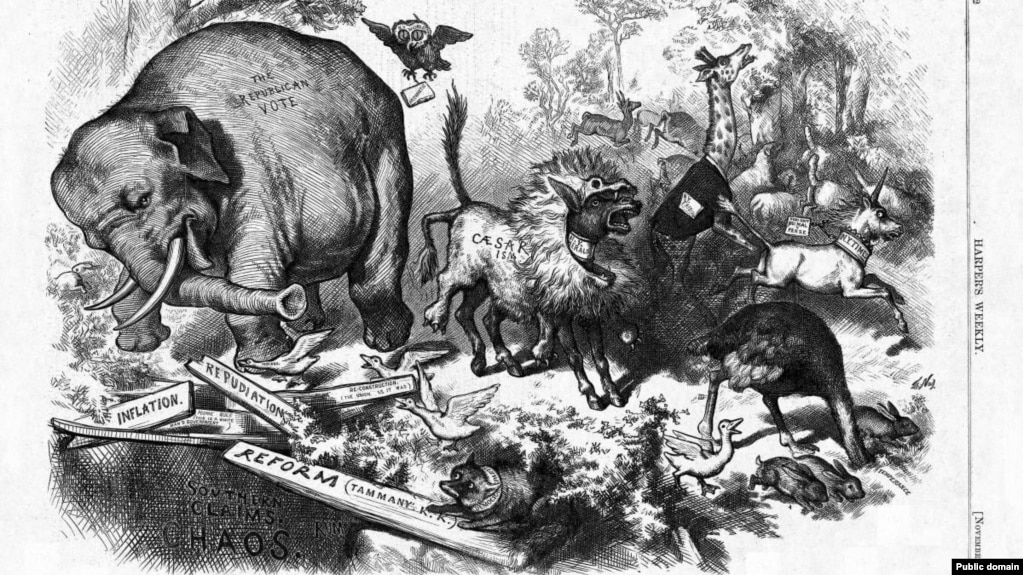
Image result for elephant representing republicans nast
Thomas Nast: "Third Term Panic"
In an earlier blog I mentioned how the symbol for the Democratic Party came to be a donkey. Thomas Nast, a political cartoonist for Harper's Weekly associated the Republican Party with the elephant in 1874 and other political cartoonists have been using it ever since.


You've probably heard of a gaggle of geese or perhaps an exaltation of larks, but did you know the collective noun for pachyderms (from the Greek pakhús, thick, and dermus, skin) is a memory of elephants?


Sunday, June 3, 2018

MOUNTAIN LION LADY: Chapter 5 (second half)

Ray took the snowmobile out for a practice run. It was a government one and, true to form, it broke down. After much exertion he jury-rigged it enough to make it back to the truck then hauled it into Canon City, the only nearby town with a garage that could fix such beasts. On the way the brakes on his truck jammed and burned through costing him $170 to repair. Exhausted, he returned to camp late that evening.

Ray woke up at 12:30 am short of breath and with chest pains. Ken pounded on my door until I was awake and fairly lucid then left me with Ray while he went to Ed's to phone the doctor. I tried to keep Ray calm and talked all manner of nonsense to try to keep his mind occupied but it's about as possible to not be worried about a heart attack as it is to not be worried when you're swimming in the ocean and see a triangular fin coming your way! All of us made it through the night and at first light headed down the canyon to the nearest hospital.

After extensive testing the doctors decided it had not been a typical heart attack but Ray would have to take it easy for a while. Wrestling snow mobiles and lions was not in the cards for him any time soon.

Although we were happy that Ray was not in as bad shape as we feared, we were bummed that we would have to find another houndsman pretty late in the season. Most of them were already booked up with hunters. We headed back to Fort Collins and Ken started calling men that Ray had suggested. We thought our luck had changed when we found one of his friends was available. We arranged to meet Joe at camp the following Sunday.

A nicer guy than Joe didn't exist. He never had a bad word to say about anyone even when we met with further hardships.

The first day out we broke through a four-inch crust of iced snow and high-centered in the foot or so of soft snow underneath. It took us about three hours with two shovels going continuously to heave the wretched stuff away enough to back out. My muscles complained for days afterwards.

While Ray had been waiting for his brakes to be fixed on his truck he had struck up a conversation with a young fellow who offered to show us some good lion country and supply us with horses.  He gave Ray his phone number which Ray had left with us. We called him up and made arrangements to meet. With that one phone call we landed ourselves in the middle of an old-fashioned, no-holds-barred family feud. We didn't realize it for a while but wondered why Lee's aunt wasn't more cordial. Most of the folks in the area were friendly and nice. We later contacted Lee's cousin about looking for lion sign on his land which was next to Lee's. He screwed up his face into a scowl and snarled. "You can but if you bring one of those #*&#!*&* horses I'll shoot it!"

We never found out what the feud was about but the lines were certainly drawn.

Four days later Specks, Joe's best dry-ground dog (the dog with the best sense of smell) got too close to a horse's heels and was kicked for her efforts. Her femur was neatly snapped in two. The vet set it but Specks like Ray was out for the season.

Birds were plentiful. We saw a pair of golden eagles almost daily and spotted a great horned owl, several spruce grouse and quite a few wild turkeys. Lion tracks were not as plentiful. We hunted for six days. The hounds got some lion scent from a couple of old tracks but not enough to follow very far. We heard via the grapevine that some people didn't think we were working very hard. If getting up at 5 am and riding until late afternoon but finding only a few unproductive tracks isn't working, I'd hate to really work! One of the accusers was an arm-chair expert to whom his coffee break was the most important part of his day. Or maybe lunch was - he was developing quite a paunch! I think he was jealous that I, a mere woman, was getting to scout for lions.

After an abortive two weeks I returned to the welcoming arms of my husband for five days then prepared to brave the mountains once more.

Six days after we returned we had a lion, albeit not in an orthodox way. We had hunted all day without success and had just settled down to the crock pot dinner I had left cooking. Our neighbor John was late in arriving and came running over shouting that we had a phone call. It was the local game warden and he said a lion was caught in a leg-hold trap set for bobcat west of Canon City and asked us to come immobilize it. We skipped supper, grabbed our gear and the three of us headed down the canyon. We met the game warden Dwayne in town and he directed us to a little box canyon just off the Arkansas River. The road ran across a bridge quite a ways above the floor of the ravine. Dwayne had a spot light that he aimed down the draw. We could barely detect the glow of the lion's eyes in some bushes but we could hear it thrash around. I asked Dwayne how big it was. 

"Oh it's a whopper - 140 pounds at least!" he answered. I loaded the dart with enough drug for a big animal.

We asked Dwayne to accompany us down the faint trail to the canyon floor but he demurred.

"I'll stay up here and shine the light on him so you can find him." he volunteered.

Joe, John and I scrambled down the little trail and cautiously crept forward, losing sight of the cat until we almost stumbled over it. It was scared and hurting.

The first shot immobilized a nearby rock, but the second shot was a good one in the shoulder. The lion was down in five minutes. We gently removed the trap and discovered it was a female, not a whopping big male. We doctored her toes with an antiseptic salve. When we weighed her we discovered she was only 80 pounds! She had gotten almost twice the dose that she should have!

I named her Francois since names are easier to remember than numbers, but officially she had #1 tattooed in her ear. I was afraid my first lion would be a mortality and there were plenty of folks around for a wake. Quite a crowd had gathered on the bridge, including a newspaper reporter and photographer.

Dwayne left his post by the light and helpfully brought the newspaper reporter and photographer down, but not before he had posed for a few pictures ("local hero radioing for help", "local hero holding the spotlight". etc.)

We had made most of the easy measurements we needed but I had left the blood draw for the last. I had only drawn blood from one zoo lion and was not feeling very confident. I trimmed the hair away from inside her knee, tied a rubber tube around her leg and miraculously a vein popped up! I surprised myself further by my lack of difficulty in drawing the blood even with five people peering over my shoulder. We put a red nylon rope collar with a plastic numbered tag around her neck, tattooed her ear, gave her a shot of penicillin and stood back, unsure of what would happen next. Would she die? 

I was loathe to leave her. The night was chilly so I covered her with my coat then we sat back and I prayed. Most of the crowd dispersed. After an hour and a half she lurched forward, wearing my coat rakishly over her shoulder, and headed for the river. Dwayne and John headed in the opposite direction. Joe and I dashed after her and aimed her back uphill then walked with her until she collapsed. After two and a half hours she could negotiate pretty well so we left her.

Francois wasn't the only one staggering. It was after midnight and our last meal had been more than 12 hours earlier. It had been a meager lunch at that. We stopped at an all-night restaurant on the way home. After an hour of making blood slides and centrifuging samples I stumbled into bed. 

Joe and I returned to the box canyon the next day. I was half afraid we would find her lifeless corpse. Sure enough, right next to the boulder where we'd left her lay Francois. Joe headed down the path to retrieve the body. But the corpse wasn't lifeless! As soon as she heard the rattle of the stones dislodged by Joe's descent she was up and behind the boulder. Joe, the intrepid, gentle man, just kept walking toward her talking softly. When she realized she wasn't hidden Francois with the grace of a bird in flight leapt up to a crack in the canyon wall that couldn't have been more than two inches wide, faltered once, then disappeared over the rim. I have never seen anything so breath-takingly beautiful! She was liquid motion like a wave flowing over the canyon wall. I couldn't even tell which foot had been caught in the trap. I was sad when she was killed by a hunter three years later.


Sunday, May 27, 2018

MOUNTAIN LION LADY: Chapter 5 (first half)

Print from hind paw of male lion

A-stalking We Will Go!

The project for my master's thesis involved capturing, marking and measuring wild mountain lions. The procedure sounds quite simple on paper: find a fresh lion track, turn three or four hounds loose on it, follow the hounds' baying (Chuck, the third houndsman I worked with, stressed quite strongly that I never speak of a hound barking!), locate the treed cat, immobilize it with a dart gun, mark it, take blood samples and measurements, and skedaddle. In practice it was never that straightforward. 

After the laborious groundwork (find out from game wardens, ranchers, etc. where the highest density of mountain lions are in the state and pick a reasonable-sized project area within that range, choose parameters to measure that might change with age (looking towards my Ph.D. project), gather equipment, select an experienced person with hounds trained to hunt mountain lions, carry out public relations with locals in the project area, find or set up a base from which to operate, and so on), we arrived in the sleepy little mountain town of Victor that was once the scene of boom-or-bust mining and would later become the scene of destination gambling. A salty character named Ray was chosen to be the houndsman.

Ray always had a good yarn to tell, often from his army days during the war when he was a cook. One of my favorite stories was about a ne'er-do-well who often landed in Ray's kitchen for KP duty. One day practically the whole company came down with the trots making a visit from the health inspectors necessary. Ray was indignant and exonerated because nothing could be found. By the time the inspectors had written up their report everyone had recovered, so the cause was marked "unknown". The unfortunate ne'er-do-well who had hovered anxiously in the background during the inspection approached Ray timidly.

"Promise ya won't bust me if I tell yer something?" he asked.

Ray eyed him suspiciously but agreed not to.

"I was a-stirrin' the stew when I 'membered I hadn't washed mah hands so I did it real quick, a-tryin' to keep stirrin' but the soap fell in an' I couldn't get 'er out so's I just stirred 'er up real good."

We had a nice field camp established in what was sort of the front yard of an old miner's cabin. We had two small trailers set up, one for me and one for Ray (and my advisor when he visited). We had all the comforts of home, sort of. We had gas heat, soft beds and electricity but no running water. For electricity we had extension cords running to the porch light on the cabin. For water we had five gallon cans that we could fill from the cabin.
Summer view from outhouse door
View through outhouse gaps


For toileting facilities we had an outhouse nearby with a view. It was perched about 20 yards from the trailers on a little hill. The schoolhouse was situated on a neighboring hill and the town's main street stretched out in front from the bottom of our hill. Since it was winter the boards didn't fit snugly so it was well ventilated plus we had a view of the schoolyard and the main street. For bathing facilities we had to have the cooperation of the cabin's resident, a young mining engineer named John. If Ray or I wanted to schedule a shower we would make arrangements with John to stoke up his wood-burning stove in the morning so the big tank of water attached to it would be warm by evening. After supper (John often joined us) Ray or I would trot over to his cabin, soap and towel in hand. We were fortunate that John was a good-humored chap. He had twinkling eyes and an impressive chin bush.

One evening when John wasn't home I went into his cabin to use his shower. I startled a huge tabby cat who careened around the room, knocking things every which way until he escaped out the front door. Later I asked John about his skittish cat.

"What cat?" was his puzzled reply.

We first arrived in the icy month of December. The wind whipped the snow from the ridges as soon as it fell and piled it deep in the valleys. Bears have the right idea in that country - they hibernate from late fall until early spring. That was part of the reason we were venturing forth at that inhospitable time of the year. Most lion hounds would rather follow a bear than a lion. I guess bears are a lot smellier than lions. The best time of year to catch lions is when bears are out of the way. In spite of our timing we ended up treeing a few bears and believe me, bears are not sober citizens when they are treed! The have tempers that would try a saint! Another reason lions are usually hunted in the winter is tracks. It's easier to spot a track in the snow than on dry ground.

The plan was to spend a week scouting the territory then begin looking for lions in earnest after Christmas. A lot of snow had fallen the first couple of weeks in December, more than twice the usual amount. It was difficult to move around on the back roads even with our four-wheeled drive so we resolved to bring snowmobiles back with us after Christmas.

Our trailers had been set up when the weather was still mild in the fall and were winterized and ready for us when we got there. I arrived with my graduate adviser Ken the day before Ray. Ken excelled in remembering people's names, diplomacy and giving his students space to learn for themselves. Ken and I were rank beginners in the lion-tracking business so Ray took us out to show us the ropes. We started by walking down the road, scanning the sides for lion sign.

"I found one! This looks like a lion track," Ken shouted gleefully from his side of the road.

"We-ahl," said Ray with a twinkle in his eye as he straightened up after examining the track, "I b'lieve that was a mighty small lion. It looks to me like a mouse hop."

We had arranged for a helicopter to fly Ray over the study area after we got back from the Christmas break. He talked the rancher who owned the land where our trailers were parked, Ed, into coming along to point out various features of the terrain. I would have given my eye teeth to go along but there was no room.

Ray slyly volunteered to make breakfast the morning before his grand adventure. We were served scrambled eggs with what looked like little chunks of cheese. It tasted just fine. After breakfast Ray chuckled and explained he had wanted to use up the eggs left over from before Christmas. I thought he was kidding. He wasn't. The eggs had frozen and the thawed hardened yolks were what we had thought were cheese chunks. He was tickled to have put one over on us and been economical at the same time. We suffered no ill effects but I vowed to be less trusting of what he served us after this. Unfortunately I wasn't to get much of a chance.

The helicopter arrived at the helipad in good time and we took Ray and a very wan Ed out to meet it. Ray claimed to be a bomber pilot after his time as an army cook and was looking forward to the day with relish. Ed didn't really trust anything that left the ground except chickens. He had only consented to the trip because his buddies had been razzing him.

While Ray and Ed were flying Ken and I scouted around a bit then Ken suggested I practice using the tree climbers. A tree climber is a wicked-looking, sharpened steel bar with straps to hold it onto the leg and a short bar for stability under the foot. Equipped with one climber on each leg, a heavy belt around the waist with an attachment that goes around the tree, a person is ready to climb a tree, Ken says. I strapped the works on, walked bow-legged to the tree to keep from planting the sharpened points in the ground, joined the tree trunk to myself with the extra strap, and slowly ascended. It was kind of fun and gave me a feeling of accomplishment! The only problem was the weight. I was going to be packing around a fair amount of equipment and the climbers were heavy!

We met the returning helicopter and were told the flight was uneventful. Ed had a little extra swagger in his step when he stepped down. He had no desire to repeat the performance but I'm sure he let his buddies know that he had actually done it while they had only talked about it.

The troubles that were to plague us the rest of the season started the next day.