Followers

Sunday, September 9, 2018

MOUNTAIN LION LADY: Chapter 9 (second half)

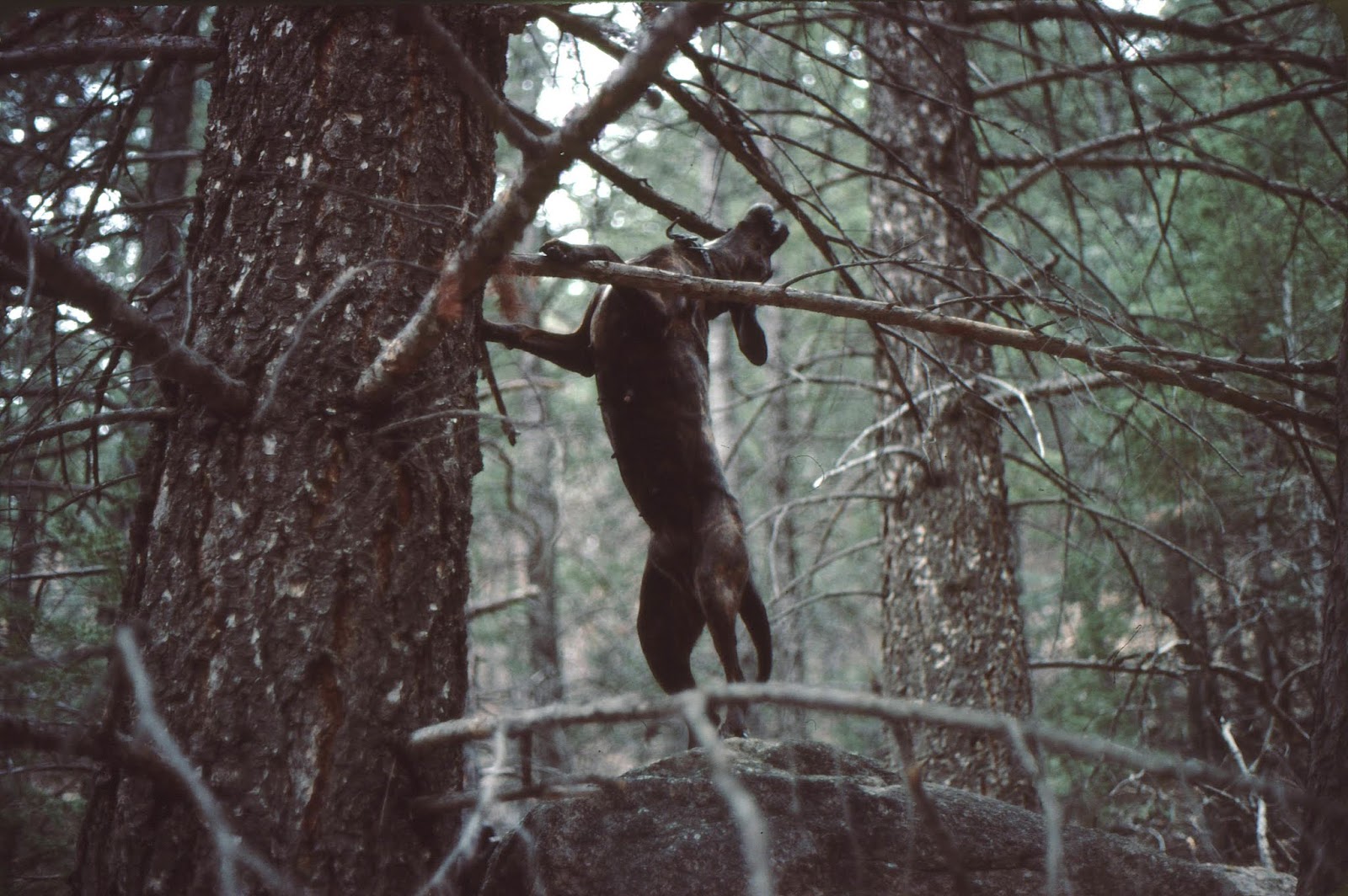
Dixie the hound barking treed
Chuck set Pup and Dixie, a young Plott hound, loose on the track, forcefully pointing them in the right direction. Bobcat was so annoyed with his hounds he decided to let them run until the track got cold which it always does if you're going the wrong way! He took off with Chuck after his hounds. Jake was left behind. He was the old hound who was missing and eye and had a crook in his tail where a bear bit him. Chuck figured he had worked hard enough staying out all night. Jake was really bummed at the situation and started howling! Gray and I decided to keep him company for a bit and eat our lunch before following the others. 

As it turned out that was a lucky decision and Jake got to be the hero of the day! Gray had only taken a few bites of his sandwich when he looked up and said, "Here comes a hound back!"

"It's the lion!" She must have treed again and the tired hounds had overrun her just like Bobcat's had done. She was sneaking back the way she had come. As quickly as we could we turned ol' Jake loose and he took off like he was a fresh young pup. He had seen her too! Within five minutes he had her treed and knew it! Even though he was hoarse he joyfully bayed for all the other hounds to hear and they came running from far and near.
Gray and Dixie the lion

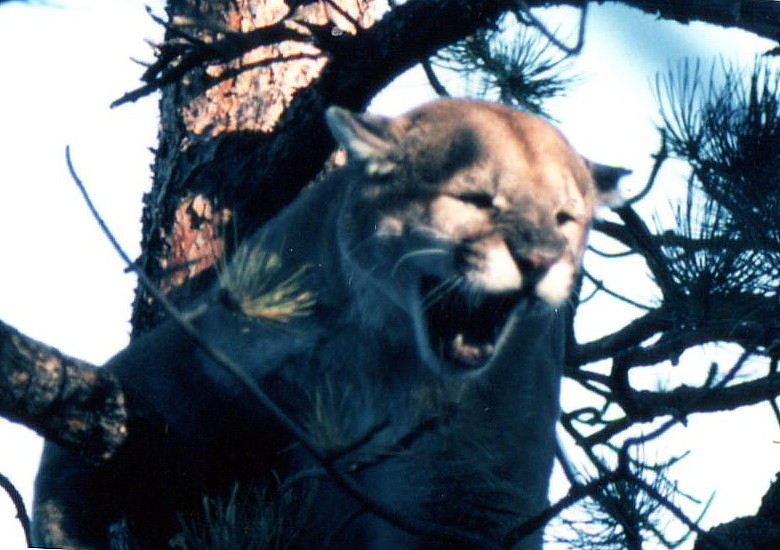
We rounded up all the hounds and leashed them before I darted her. They were quite content just to lie down and watch. It had been a full day (and night!) for all of them. She was a mature female and we gave her the red numbered tag 8. I named Dixie because Dixie hound had helped capture her. Too bad she wasn't male and I could have named her Jake! Looking back I should have named her Judy for the helter-skelter Punch-and-Judy drama she caused!

When we got back to camp there was a message from Ken. He had gotten a call in Fort Collins from the Cheyenne Mountain Zoo in Colorado Springs. A mountain lion had wandered through the zoo and killed a snowy owl during the night and they wanted us to come catch the lion. I didn't think the hounds could take another chase so soon so I called them and said we'd be there first thing in the morning.

The snow was spotty but we could see what happened. The mountain lion,  probably a young one looking for a place to call its own, had meandered through the outdoor exhibits. Instead of sleeping tucked up against the wall the snowy owl must have fallen asleep right next to the bars. Maybe it got hot during the night (hmm - do owls get hot flashes?). The cat had reached a paw through and killed it but couldn't figure a way to get the small carcass through the bars so finally left it and wandered around some more before leaving the area. The snow was spotty so the track scent had dissipated with the melting. The hounds couldn't find enough to trail it out of the zoo. We asked the zoo director to let us know if they had any more trouble. We didn't hear from him again that season.

It was time for a break and for the first ever mountain lion workshop. Gray and I drove home to Fort Collins after our fruitless search at Cheyenne Mountain Zoo, ate dinner at Furr's Cafeteria, packed and went to bed early. The next day was going to be a full one!

Our morning started out with a bang. Literally!


Sunday, September 2, 2018

MOUNTAIN LION LADY: Chapter 9 (first half)

Best of Times
Fat Albert awake!

We were stoked! This season was going really well. We'd been in the field five days and treed a lion on three of them! That's almost as good a record as a mountain lion has on the days it hunts. 

We left camp about a half hour before dawn and met one of the outfitters we'd worked with before who was nicknamed Bobcat and his friend. Bobcat and his friend took one truck and Chuck, Gray and I took another. We split up near Long Gulch. Bobcat found a large track that wasn't very fresh and so drove up the power line road to see if they could find a fresher one, possibly where he had crossed the road further up. No such luck so they returned to the original one and turned Bobcat's hounds loose on it then radioed us. We later discovered they had missed a fresher track in a bunch of deer tracks. It would have saved us a lot of effort if they had found it. As it was they muddled around trying to get the track sorted out.
Nipple Mountain

When Gray, Chuck and I arrived we could hear the hounds trailing and decided to drive further up the road. We found what we thought was the same track as it continued north. We turned Chuck's  three hounds loose and followed them on foot. We traveled north most of the day until we were almost across from Nipple Mountain when the track turned west. Sometime during the chase Bobcat's hounds had joined Chuck's. 

Bobcat and his friend found us and we continued following the hounds until dark. It sounded like the hounds had treed the lion in some very rough country nearby but I probably wouldn't be able to see the lion well enough the dart him. We decided to leave them all doing their thing and come back in the morning. Bobcat's friend wasn't used to such exertion and was feeling nauseous so Gray and I stayed with him next to the road while Chuck and Bobcat hiked down to a nearby ranch. The rancher drove them back to their trucks then they came and got us.

The next morning we drove as close as we could to where we had heard the hounds barking "treed" and set out. We couldn't hear them yet so we climbed a high ridge hoping the sound would travel to us. It was steep and rocky but when we got to the top a faint sound could almost be imagined. We clamored over the next ridge and could definitely hear the occasional bark. It was not the constant baying of excited hounds looking the lion in the eye but it was enough for us to locate them.
Asleep

What a sight we saw! Most of the six hounds were exhausted but happy to see us. They immediately perked up and started baying albeit hoarsely again. The lion looked so peaceful sleeping in the tree. He looked big so I named him Fat Albert. We tied up the hounds then I took careful aim and darted him in the flank. What a wake up call! He snarled, checked out the scene and bailed out of the tree. We were afraid of a repeat with the faulty dart with Mickey Mouse so Chuck put Pup on a leash and started following him immediately. We didn't need to worry. Fat Albert succumbed to the drug a short distance down the hill.
Leaving the tree

Fat Albert waking up
Bobcat took his hounds back to the truck while Gray, Chuck and I processed Fat Albert. All went smoothly. When he started to rouse we left him. On the trail back we met an excited Bobcat sans hounds. In the two hours we had been working with Fat Albert another mountain lion had passed behind the truck! Bobcat had turned his revived hounds loose on the track and come to get us. 

A depressing sight met us when we arrived back at the truck. Bobcat had started his hounds off in the right direction but at some point the lion must have treed unbeknownst to the hounds. They were so excited because the track was so fresh that when they didn't find any more tracks going in the direction they were headed they turned around and followed the back track which smelled just as good. Bobcat threw his hat on the ground in disgust.

What happened next was like slapstick comedy!


Sunday, August 26, 2018

MOUNTAIN LION LADY: Chapter 8 (second half)

Mickey Mouse asleep in the tree
This lion had earned the name Mickey Mouse. We followed the hounds who were following the lion up Long Gulch over a couple or ridges and down a side gulch before he finally treed again. This time he picked a taller tree and climbed way up to the top. I darted him in the flank with a reduced dose since I figured he must have gotten some of the first one. We tied up the hounds and started throwing snowballs at him to try to get him to come down. He must have figured bailing out didn't help the first time so he wasn't going to try it again. He fell asleep high in the branches. Chuck volunteered to climb up and fetch him down. We didn't have the heavy tree climbers so with the rope looped over his shoulder Chuck had to make the most of each little branch and rough place on the trunk. The plan was to get the rope around the lion's chest and lower him to the ground but his chest was the part of his anatomy that was farthest away from Chuck. Another problem was that the branch didn't look like it could hold both a big lion and a big man and the big lion had first dibs. Chuck decided to try to lasso the rope around a hind leg while he stayed as close to the trunk as possible. Gray climbed up the hill to get a better vantage point to take a picture while I watched and fretted.
Chuck maneuvering the rope

Chuck successfully got the rope around the Mickey Mouse's foot and tried to ease him off the branch without the branch and both of them coming down. It was with a sigh of relief as I watched the lion descend toward the ground. Unfortunately my sigh was premature. The rope broke part way down and he tumbled the rest of the way like a sack of potatoes. No bones seemed to be broken but he was probably pretty bruised from the fall. The first dart was still hanging from his foreleg. The carbon dioxide charge that is supposed to go off on impact to shove the plunger down hadn't fired so Mickey Mouse had only gotten a wee dribble of the drug. 

He started to come out of the anesthesia before we were quite done. We had made our measurements and hurriedly took our samples then backed off to make sure he recovered. In a short while he got up and wove off down the hill. He moved like a drunk but not an injured one.

By this time it was quite dark so we hiked about 6 miles to the nearest rancher and called the local game warden for a ride back to camp. We returned the next day to get the truck.

Two days later we went hunting in a nearby area with two local guide-and-outfitters. It had snowed the day before so tracking conditions were pretty good. We found a track crossing the road and turned some of the hounds loose. After a short half-hour chase we heard them baying treed. When I peered up into the tree I could see a red nylon collar on the cat. Mickey Mouse stared defiantly down at us! He had traveled some 15 miles in the last couple of days so we knew he was going to be all right.
Mickey Mouse re-treed

Sunday, August 12, 2018

MOUNTAIN LION LADY: Chapter 8 (first half)

New Season, New Strategy

"Failure is nothing more than a chance to revise your strategy."
                                                                - anonymous

 We revised several things before the start of the second season. We increased the study area size and shifted it south to lower elevations up and down the Arkansas River basin. We moved the two trailers to west of Canon City where we had access to a real toilet and shower. We changed houndsmen. We hunted for tracks from a truck rather than horseback. I had a new Cap-chur gun. We kept two essentials: checking the same parameters of the mountain lions and a woman leading the study.

I took necessary classes at C.S.U. during the fall semester but was ready to go hunting the day after New Year's Day. Tracking conditions didn't look good when we arrived in an almost snowless Canon City. 

The next day my advisor Ken and I drove in one truck and our new houndsman, Chuck, in another. Fortunately conditions improved somewhat as we drove up the Arkansas. After maneuvering around some twisty ranch roads Chuck walked down a gulch where some lion tracks had been seen before Christmas. He wanted to catch a lion! Alas there was no lion sign. We had coffee with the rancher and Don the houndsman who had helped us the previous year. We decided to give another area a try and drove east. We cut a fairly large  track crossing the road. Chuck turned a few of his hounds loose on the track and Don set some of his on the track too. While following the hounds we came across a kill but the track the hounds followed away from the kill were smaller than the ones they'd followed going in. They were probably fresher than the larger ones.
Lion kill

We were lucky that the area was well-riddled with ranch roads because Ken and I were able to drive to within about a quarter of a mile from where we could hear the hounds baying "treed". We hustled to help Chuck tie up the hounds nearby. I loaded the dart and aimed. I had neglected to sight in the new Cap-chur gun so the first shot immobilized the branch under the lion.
Darting Pinon Penny
The second shot flew true and the lion bailed out with no urging. Chuck put a leash on Pup, his black-and-tan hound with the most intelligence and followed the fast-disappearing lion. About 250 yards from the tree the drug took effect and the lion collapsed. 


The lion turned out to be a 95-pound female with beautiful adolescent eyes. I didn't know it at the time but mountain lion's eyes usually go from blue at birth to kind of a muddy brown color to golden at adulthood. I named this lion Pinon Penny. Her eyes had a ring of chocolate color around the pupils then a band of turquoise flecked with gold followed by an outer band of gold. Gorgeous! She probably had become independent not long before and was not yet the superb hunter she would later develop into. Her hunger may have driven her to investigate the old kill on her unlucky day.
Pinon Penny after processing

At one point Pup who was tied nearby started chewing on her tail but no damage was done. Jake, a scrappy old Walker with a kink in his tail where a bear bit him and a missing eye thanks to another bear, got loose but he ignored the immobilized lion. She was slow to recover after we had finished with all of her measurements and samples so Ken and I stayed with her for a couple more hours to make sure she was OK.

Wow! Two days into the season and we already had a lion under our belt! That evening Gray arrived on the bus and I recounted our hunt in great detail. I could just tell this was going to be a good season!

The next morning with Ken and Chuck in one truck and Gray and me in another we drove up Shelf Road towards Cripple Creek. The drive is beautiful but rugged in the summertime. In the winter it is still beautiful but treacherous in the snow. I cut my teeth driving it in four-wheel-drive in the winter. It must be approached with confidence, something Chuck had in abundance but something I had to learn quickly. It was good that there wasn't a lot of snow my first time.

We met Don and his wife Amy on the High Park Road. Gray and Ken took one truck and went east while Chuck and I followed by Don and his wife went toward Scratch Hill. Neither Ken nor Gray were as experienced as Chuck so it was no wonder that we found the first track. Chuck turned his hounds loose. He was our expert in all things to do with the hounds so when he told Don he couldn't use his hounds we had to go with it. Don was miffed. 

Pretty soon the confusion began. The hounds went up the draw around the hill and to the road from where we had chased Pinon Penny the day before. "Ah, fresh track" the hounds probably thought and took off with glee. We finally were able to contact Gray and Ken. They had been trying to use only Don's radio which wasn't compatible with the one we had and Don didn't have his turned on. They figured that out and switched. We left them with hurried instructions and took off after the hounds. We didn't want to tree Pinon Penny again so there was a mad scramble to round up the hounds. We couldn't find Boone, one of Chuck's brindle Plott hounds. Don and Amy had gone home when we had started rounding up the hounds. Ken, Gray and I went back to camp while Chuck hung around waiting for Boone. We hadn't gotten a lion but the day had still been exciting!

The next day we didn't have such a large entourage. Ken had gone back to C.S.U. and Amy had to go to work so she and Don weren't around. Gray and I took one truck and Chuck and the hounds the other. Near Gooseberry Creek off the Tarryall Road we found a deer kill. There were large mountain lion tracks all over the place! We circled the area with the hounds on leashes trying to find where the lion had left the kill. Chuck thought he had found it and turned three of his hounds loose. They soon scattered in different directions. Chuck and I tried to stay with Pup. Gray took off after a different hound. He soon lost the hound and went back to the truck. He drove up and down the road listening unsuccessfully for baying then decided to follow our tracks. 


Dixie baying "treed"
The hounds had paid attention to each other and when the going got rough on one track they would go to the hound that was still baying. Chuck and I finally caught up with them when they were milling around in a bit of a rough patch. 
"This lion is really Micky-Mousing around" Chuck complained.
We circled the area and found where the track left the vicinity and turned them loose again. Down we all went into Long Gulch then up over the ridge again. I was getting pretty tired when we heard the hounds baying "treed". 

He looked big and felt pretty secure in the branches surveying the yapping nuisances below. I had sighted the gun in after the mishap two days before so I took careful aim. The preferred site, the hind leg, was obscured by branches so I aimed for the foreleg. The dart struck him right on target! We waited a couple of minutes and then backed the hounds away so he would be encouraged to leave the tree. The tree wasn't feeling like such a secure place anymore so he literally leaped at the chance and took off down the hill. Chuck followed with Pup on the leash. I came along a bit later with the rest of the leashed hounds (quite a hand full!). After about 300 yards when he still hadn't succumbed to the drug we decided he wasn't going to so we turned the hounds loose again. We were in for another chase. The result wasn't going to be as smooth as the first and Gray had yet to find us.


Sunday, August 5, 2018

MOUNTAIN LION LADY: Chapter 7 (second half)

The idea for a zoo in Salt Lake City started out in 1911 as a display in Liberty Park of a cageful of monkeys to which a deer was added a bit later. A year later the Salt Lake Parks Department decided a zoo would be a good idea and with an investment of $153 purchased five pairs of exotic birds, a pair of foxes, a pair of squirrels and a pair of white-faced ring-tailed monkeys. The collection was expanded and a new building built, the "Happy Family Building" that housed lots of birds but also about 100 rabbits. Admission was free. 

By 1916 the zoo entered the big time with a purchase from a travelling circus of Princess Alice (named after Teddy Roosevelt's daughter), a 31- or 32-year-old Asian elephant. The $3250 cost was mostly raised from small donations by schoolchildren. By now there were more than 275 animals, mostly from North America, 26 of which were donated. Princess Alice may have been pregnant when she arrived because gestation in elephants is almost two years and she gave birth in 1918 to a son later named Prince Utah. He was almost a year old when Princess Alice rolled over on top of him and killed him. The newspapers reported that she mourned his loss with tears and trumpeting. Periodically in the next twelve years she would make a break for it and amble through back yards in the neighborhood breaking fences and clotheslines. Mr. and Mrs. James Hogle in response to the outpouring of community concern donated the parcel of land where Hogle Zoo is presently located in 1931 largely so Princess Alice would have a more secure cage. In August of that year Hogle Zoo reportedly opened its doors to a crowd of 14,000 (I think it more likely that 14,000 was the number of people that visited it in a year). For a while Alice was secure.

People are nothing if not fickle and by 1934 the water supply was cut off to the zoo due to nonpayment of their $195 bill. The zoo director threatened to turn all of the animals loose if the water wasn't turned back on, which it was. By 1941 the zoo was in terrible shape. One article in the Salt Lake newspaper published June 19, 1941 was headlined "Bad Odor, Old Cages, Garbage - That's Salt Lake City's Zoo". Mr. and Mrs. Hogle requested the return of their land. It must have improved because the next year the newspaper reported that the zoo's oldest lion had died "due to the shock of living in new, clean, comfortable quarters."

Some visitors to the park looked upon the animals as fair game. A boy killed one of the zoo's deer with an arrow in 1943 and a polar bear received a non-fatal gunshot to the head in 1946. Thereafter the director said guns on the grounds would be confiscated and people harassing the animals would be punished.

Left entrance sculpture
Right entrance sculpture

In 1947 the two beautiful sculptures of mountain lions by Dr. Avard Fairbanks that adorned the entrance when we visited the zoo (now no longer there) were erected. That was also the year Princess Alice forced open the doors of her building and charged through the neighborhood, uprooting a tree and destroying a drinking fountain. After her romp (rather impressive for a 62-year-old!) she calmly returned to her quarters. Six years later she became ill and was put to sleep.

A new mountain lion exhibit was constructed in 1960 and by the time we visited in 1975 they had nine mountain lions, an overpopulation in my opinion. Now they don't have any. An underpopulation I would say!

In 1969 the 37-year-old zoo director was fatally bitten by an African puff adder. Antivenom serum was flown in from San Diego and given as soon as possible but it didn't save him. He was replaced by the director we met at the time we visited Hogle. 

When we visited Hogle Zoo in 1975 we had several zookeepers helping us so everything moved rather quickly. It was sort of like an assembly line. We were stationed in an area behind the exhibit and the comatose lions were brought to us one by one. Or sometimes two at a time. The first three females then a couple males passed through our hands complete with recorded measurements and blood samples. As soon as all the lions were out of the big cage they started putting the recovering ones back in. It all went smoothly until the last male was put back in before he was fully recovered. He must have fallen or one of the other males must have decided to take advantage of the state he was in and knocked him off the rocks, killing him. I was numb with shock when I heard about it. That wasn't supposed to happen! I was reminded that haste indeed makes waste because this tragedy could have been prevented. It was with heavy hearts as we packed up and left the zoo.
Weighing an Albuquerque lion

We drove directly to Albuquerque and worked with their mountain lions two days later. Although there were only six lions there were fewer zoo keepers as well and the scene was much calmer. We had more time to contemplate each animal!

With a sigh of relief we returned to Fort Collins so I could analyze all of the data we'd gathered. We'd made it through the first year!

Sunday, July 29, 2018

BBBBBBBBBBBBBBBBBBBBBBBB

At the Davidson Fruit Company

The title of this post is an example of a rebus: a combination of letters, words or doodles that says something familiar in a new way. Can you guess what it is? It's a beeline. When a worker bee (always a female) has gathered a full load of nectar and pollen she goes straight back to the hive even if she wandered all over looking for flowers. A bee is a paragon of all work and no play, hence "busy as a bee". Unfortunately for us and European honey bees their numbers are declining. Our linden tree is usually literally humming with bees when it is in flower. This year I could see some but there were not enough to make their wonderful music. This post is about animal words and phrases having to do with work except for a digression later into some money words and one more rebus although neither has anything to do with animals.

Another animal admired by a boss is the eager beaver. This animal works from dawn to dusk cutting down trees and building dams. He doesn't seem to be playful like his fellow water-lover the otter, but is usually hard at work whenever anyone sees him. He seems to only take time out to slap a warning on the water when a person gets too near.

Have you ever heard a car salesman say "Let's talk turkey!" This phrase originated in America just like the bird and was in use by the mid-nineteenth century. Some folks speculate that it arose in colonial days when the Pilgrim fathers offered the Indians many things in return for turkeys. The Indians would greet them with "You come to talk turkey?". Others suggest it originally meant pleasant conversation or sweet nothings so a young man would try to talk turkey to his girl. Some time in the ensuing 60 or so years the turkey's gobble became sterner and the phrase came to mean to talk about basics or about cold, hard cash.

Cash, from the Latin word for box, capsa, originally referred to a money-box and later became synonymous with the money itself. Money comes from Moneta, the name of a Roman temple dedicated to Juno, the queen of the gods. Romans often had cash-flow problems (conquering is expensive) so they asked for Juno's aid. Her priests evidently helped and the grateful Romans built the temple to show their gratitude and gave it the Latin name for advisor. 

Our main unit of money, the dollar, has a round-about history too. Silver was discovered in the valley of Joachim near Prague in 1516. The Count of Schlick, owner of this mine, minted his own coins (a common practice of the time for anyone who had access to gold or silver). His coins bore the picture of St. Joachim and became known as Joachimsthaler, literally "of the valley of Joachim". Later the name was shortened to thaler. The English either not knowing or not caring that the term just meant "valley" used it to refer to Spanish pieces of eight (so named for the large "8" on one side of the coin which meant it could be cut into eight pieces or bits for smaller coins). The Fathers of our country based their new currency on the Spanish pieces of eight and called them dollars.  One quarter of a dollar is two bits.
Irish sixpence

Bartering was first done with animals and food. Later pieces of metal took the place of the actual objects. Until converting to the Euro Irish money still had pictures of animals of various values on one side of their coins. Now transactions often just use computer transfers via credit cards and banks. Have we come a long way babe?

This brings me to my final rebus. A boss pays a worker a salary. Can you guess what PAY PAY is? A toupee! Enough said!

Sunday, July 15, 2018

MOUNTAIN LION LADY: Chapter 7 (first half)

Zoo Time
The first winter season was behind me. It had not been at all what I had anticipated. I did not approach the summer with the same degree of confidence that I had gone forth in the fall. I would be working with captive mountain lions of known ages to develop a method to determine the ages of wild lions. It sounded pretty easy, but I had thought chasing wild ones would be physically taxing but straightforward. It was not. What surprises did I have in store for the summer?

A Cap-chur gun was used to immobilize all of the wild mountain lions because they were usually more than 20 feet away and up a tree.  We needed closer-up methods for the captive ones. Some of the zoos had squeeze cages. The zookeepers would urge the lion into the cage then narrow it down with a lever so the animal couldn't turn around and was pressed against the side bars. It was easy to inject the immobilizing drug directly into a hind leg muscle and let the lion back out into the big cage before the drug took effect.
Blow gun and dart 
Another method involved a blow gun. Lots of lung power was needed for this one since the same kind of dart was used as with the Cap-chur gun and the dart was heavy. Sometimes if a squeeze cage wasn't available a jab stick would be used for an animal confined in a small cage. This one was the trickiest of all since the operator had to give the lion a jab in the hind leg and pull back quicker than the lion could turn around and swat the stick. I was fortunate the zookeepers were familiar with whatever method we had to use and would usually do the immobilizing.


My tour of zoos which had expressed a willingness to let me work with their known-age mountain lions started with the Cheyenne Mountain Zoo in Colorado Springs. They had two female lions, a 13-year old and another one of unknown age. I had worked on one captive lion in Denver and two wild ones. I sort of knew what I was doing. I was lucky that everything went smoothly. 

One of the first things I noticed was the difference in the teeth. The wild lions' teeth had no tartar buildup but the captive ones usually had a great deal. This made measuring gumline recession difficult and not very accurate. The tartar had to be scraped off, sometimes leaving the gums bleeding. When I thought about it, it was pretty easy to understand why there was more buildup in zoo lions. Most of the felids in zoos were fed a soft meat product. Wild mountain lions used a natural toothbrush: rib bones. One of the markers of a deer killed by a lion was the ribs would be chewed off often almost all the way to the spine. The broken bone edges would scrape any tarter off the teeth before it even had a chance to coat the tooth.
Wild male footprint

Captive female footprint

Another difference was in the ink prints I made from the hind foot. The wild lions' feet were furry and the pads were cracked, sort of like the callouses my feet got when I went barefoot in the summer. Zoo lions' pads were as smooth as if they had been given a pedicure.

After my positive experience with Cheyenne Mountain Zoo I was feeling more confident when we reached the Brit Spaugh Zoo in Kansas. I shouldn't have been. The two animals we worked on first were females and everything went as planned.

The trouble started with the next one, a fat old male. Fat lions look the same as skinny lions from above because they carry their extra weight in a sagging belly. This old boy's belly was really sagging! Several people from the zoo were watching me so I did the easy things first. The body measurements went okay. Weighing him was strenuous but doable. A whisker was easy to snip off. Then the hard part. I got disoriented when I went to take the blood. I mistook the ankle vein for the knee vein because his belly hung below the knee vein. Ankle veins aren't very big on mountain lions. I went through the vein in one leg causing a big hematoma to form (blood seeped from the vein into the tissue surrounding it). I collapsed the ankle vein in the other leg by trying to draw the blood too quickly. The veins were too deep on the forelegs so I tried to take blood from the tongue veins. I was getting desperate! I switched to a smaller needle and my advisor Ken held the lion's tongue. I carefully slid the needle into the vein and slowly, slowly drew back the plunger. The lion had been under for quite a while and was starting to come out. His tongue was not made to spend much time out of his mouth and was drying out. To correct his discomfort he tried to pull it in. Ken hung on with determination but asked me to hurry. I didn't want to collapse this vein as well but understood the need.  I hurried and the vein collapsed with only about half the amount of blood I needed. We let the lion moisten his tongue then tried the vein on the other side. By the time he tried to pull it in I figured I'd stop when I was almost ahead. I had almost enough blood. 


Taking a blood sample from a zoo mountain lion


On to the Topeka Zoo! We were in for a delightful surprise. The young male mountain lion snarled at us from the small enclosure behind the exhibit cage. I thought I was imagining things because his canine gleamed! Teeth, even very clean teeth, usually don't gleam. The zookeeper was watching for my reaction.

"Does he have a silver tooth?" I asked incredulously. He beamed and told me the story. The lion's canine had been broken when he fell on his face after a routine immobilization and the nearby dental school had come to the rescue. The students had fitted him with a stainless steel crown. Good experience and p.r. for the students and great p.r. for the zoo! It wasn't actually necessary because a lion eating soft food really doesn't need his canines. 

Even some wild lions are able to make do without, sometimes to the detriment of ranchers. A lion was killed in Utah that had broken all of his canines and was gumming his dinner (sheep) to death with the stubs. Pretty hard work I imagine. Sheep were probably easier to hold onto during the process than deer. Another lion with a disability was killing sheep and shot by a rancher. He noticed the fur was worn off on the inside of the lion's front legs. Further examination revealed stiff wrists from arthritis on its forelegs making it difficult to grab its prey with its claws. It could hold a woolly sheep with its forelegs just fine while it delivered the fatal bite. A deer could probably have just slipped away. 

A stainless steel canine didn't make any difference in the parameters I was measuring. I just measured the gumline recession on the other side. Everything else for the two lions was routine and we thanked the zookeepers and headed back to Fort Collins to get ready for our next zoo visits.

The only real zoo tragedy happened when we visited the zoo in Salt Lake City.